Learn what every symbol on the card means.Full credits and sources at beakbrain.com/symbols
 ShrublandCup nestTiny · 10 g
ID tip
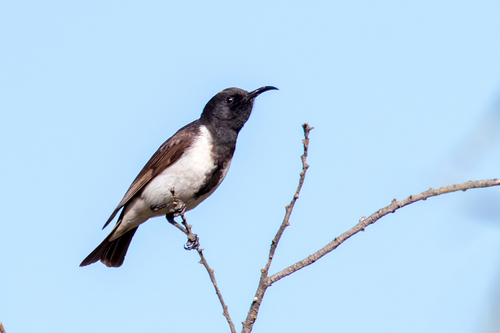
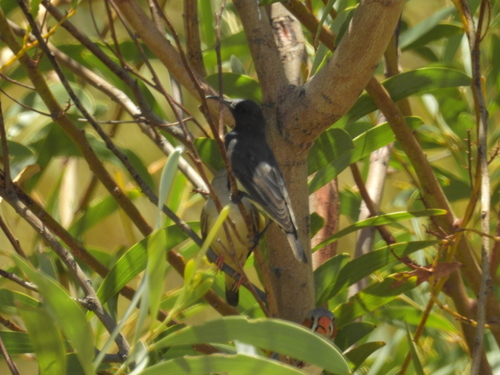
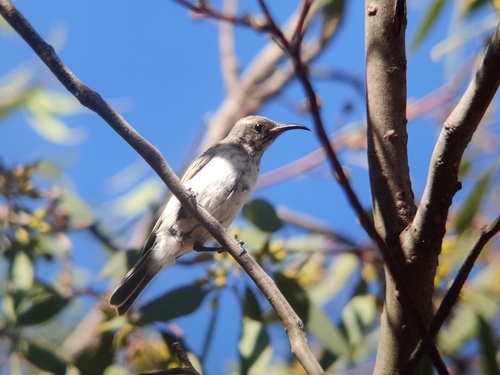
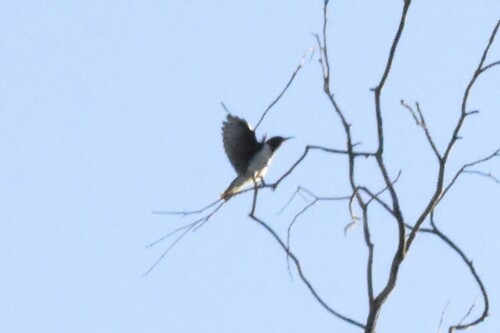
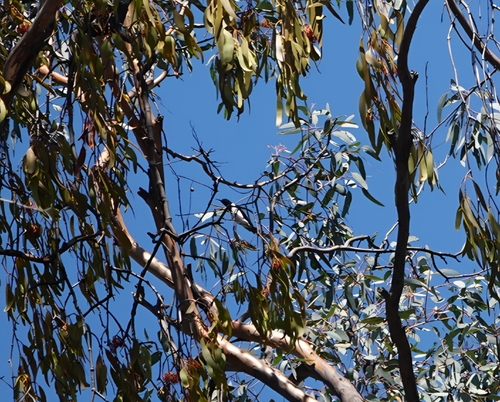
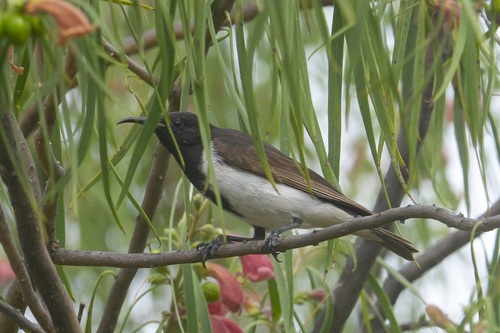
The black honeyeater has a long, slender, down-curved bill, a small rounded head and slender neck set on a plump body, and a short, slightly cleft tail. It is between 10 and 13 cm (3.9 and 5.1 in) long, with an average wingspan of around 19 cm (7.5 in) and a weight of 9.5 g (0.34 oz). It has relatively long, pointed wings for a honeyeater, and very long wings for such a small bird, the development of which has been attributed to its feeding behaviour of flying between shrubs and hovering over flowers. The species is strongly sexually dimorphic.
Text from Wikipedia, licensed CC BY-SA 4.0.
When to see the Black Honeyeater
One bar for each month. Filled bars are the 9 months with records; pale bars are months with none. The wide bar is October, the month with the most records.
Where to see the Black Honeyeater
The map shades 1 country with regular records. Everything unshaded has no records. Countries are listed below the map.
About the Black Honeyeater
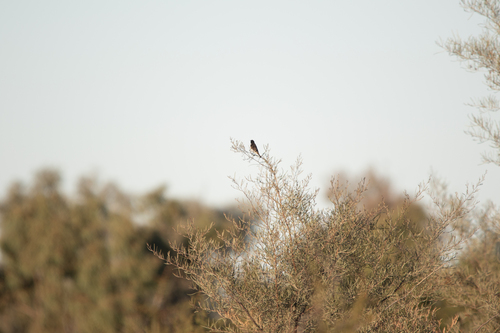
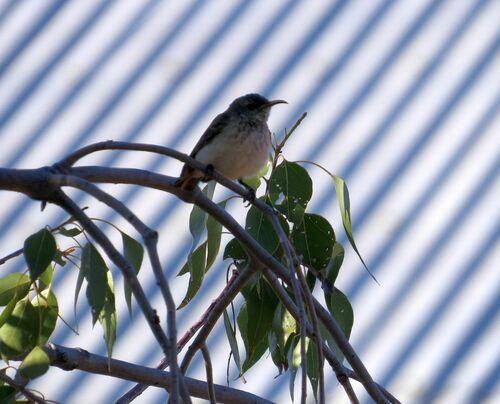
The black honeyeater is a species of bird in the honeyeater family Meliphagidae and the sole species in the genus Sugomel. The black honeyeater exhibits sexual dimorphism, with the male being black and white while the female is a speckled grey-brown; immature birds look like the female. The species is endemic to Australia, and ranges widely across the arid areas of the continent, through open woodland and shrubland, particularly in areas where the emu bush and related species occur.
Text adapted from Wikipedia, licensed CC BY-SA 4.0.
Easily confused with
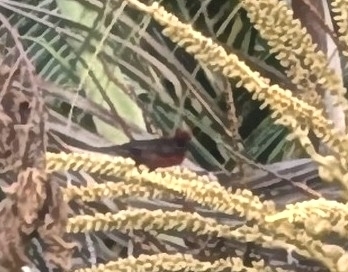 Micronesian MyzomelaMyzomela rubratraThe Micronesian myzomela is a small honeyeater measuring 13 cm in length.
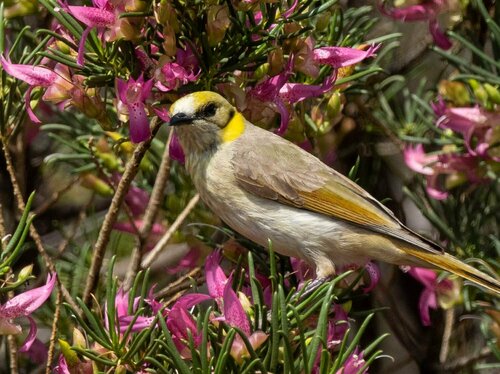 Grey-fronted HoneyeaterPtilotula plumulaThe grey-fronted honeyeater is a small, plain honeyeater with a yellow neck plume bordered above by black.
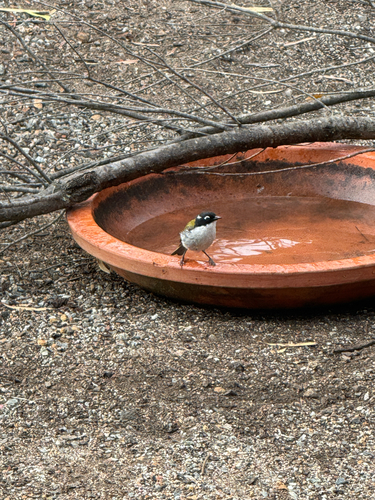 Gilbert's HoneyeaterMelithreptus chloropsisA mid-sized honeyeater, Gilbert's honeyeater has olive-green upperparts and white underparts to the undertail.
Side by side: Black Honeyeater vs Micronesian Myzomela · Black Honeyeater vs Grey-fronted Honeyeater · Black Honeyeater vs Gilbert's Honeyeater
Learn the Black Honeyeater in the BeakBrain App
Photo and call practice. Coming soon to iPhone and Android.
Play today's Daily BirdEvery photo and recording on this page is credited to its author under the licence shown. Spotted a problem with this page, or have a better photo? Contribute.