
Black Honeyeater
Sugomel nigrum
The black honeyeater has a long, slender, down-curved bill, a small rounded head and slender neck set on a plump body, and a short, slightly cleft tail. It is between 10 and 13 cm (3.9 and 5.1 in) long, with an average wingspan of around 19 cm (7.5 in) and a weight of 9.5 g (0.34 oz). It has relatively long, pointed wings for a honeyeater, and very long wings for such a small bird, the development of which has been attributed to its feeding behaviour of flying between shrubs and hovering over flowers. The species is strongly sexually dimorphic.
ID text from Wikipedia, CC BY-SA 4.0
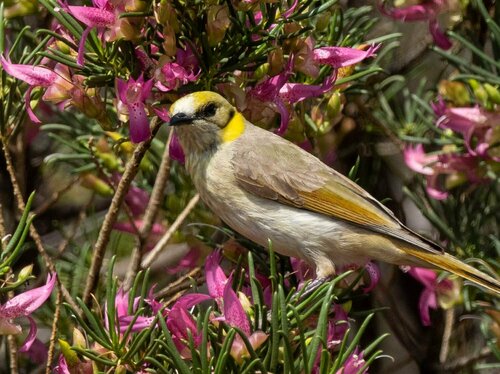
Grey-fronted Honeyeater
Ptilotula plumula
The grey-fronted honeyeater is a small, plain honeyeater with a yellow neck plume bordered above by black. It has a small grey patch at the forehead, that may be obscure in northern subspecies. The crown is olive yellow and the lores blackish. The upper parts are olive grey and flight feathers yellow olive. Underparts are off white with indistinct stripes. The grey-fronted honeyeater can easily be confused with the yellow-tinted honeyeater as their ranges overlap and they are of similar size.
ID text from Wikipedia, CC BY-SA 4.0
Where you might meet both
Learn this pair in the BeakBrain App
Photo and call practice. Coming soon to iPhone and Android.
Play today's Daily BirdPhotos and recordings are credited to their authors under the licence shown. Full profiles: Black Honeyeater and Grey-fronted Honeyeater.