Learn what every symbol on the card means.Full credits and sources at beakbrain.com/symbols
 UrbanCup nestSmall · 18 g


What the Barn Swallow sounds like


ID tip
The adult male barn swallow of the nominate subspecies H. r. rustica is 17–19 cm (6+1⁄2–7+1⁄2 in) long including 2–7 cm (1–3 in) of elongated outer tail feathers. It has a wingspan of 32–34.5 cm (12+1⁄2–13+1⁄2 in) and weighs 16–22 g (9⁄16–3⁄4 oz). It has steel blue upperparts and a rufous forehead, chin and throat, which are separated from the off-white underparts by a broad dark blue breast band. The outer tail feathers are elongated, giving the distinctive deeply forked "swallow tail". There is a line of white spots across the outer end of the upper tail. Voice: Males sing to defend small territories (when living in colonies, less so in solitary pairs) and to attract mates. Males sing throughout the breeding season, from late April into August in many parts of the range. Their song is made up of a "twitter warble," followed by a rising "P-syllable" in European H. r. rustica and the North American H. r. erythrogaster.
Text from Wikipedia, licensed CC BY-SA 4.0.
When to see the Barn Swallow
One bar for each month. Filled bars are the 6 months with records; pale bars are months with none. The wide bar is May, the month with the most records.
Where to see the Barn Swallow
The map shades 214 countries with regular records. Everything unshaded has no records. Countries are listed below the map.
About the Barn Swallow
The barn swallow is the most widespread species of swallow in the world, occurring on all continents, with vagrants reported even in Antarctica. It is a distinctive passerine bird with blue upperparts and a long, deeply forked tail. In Anglophone Europe, it is just called the swallow; in northern Europe, it is the only member of family Hirundinidae called a "swallow" rather than a "martin".
Text adapted from Wikipedia, licensed CC BY-SA 4.0.
Easily confused with
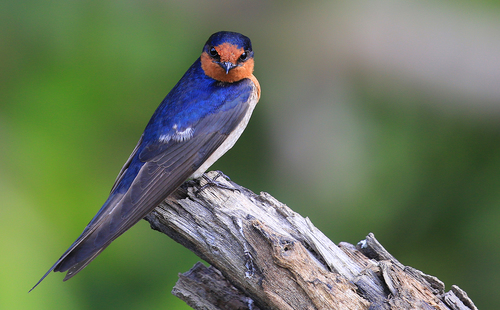 Welcome SwallowHirundo neoxenaThe welcome swallow is a small fast-flying bird.
 Pacific SwallowHirundo javanicaThis species is a small swallow at 13 cm (5.1 in) in length.
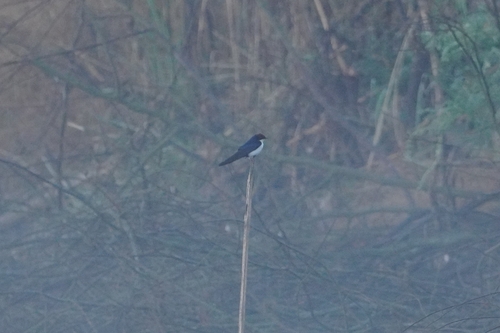 Wire-tailed SwallowHirundo smithiiThe wire-tailed swallow is a small swallow, measuring 18 cm (7.1 in) in length.
Side by side: Barn Swallow vs Welcome Swallow · Barn Swallow vs Pacific Swallow · Barn Swallow vs Wire-tailed Swallow
Learn the Barn Swallow in the BeakBrain App
Photo and call practice. Coming soon to iPhone and Android.
Play today's Daily BirdEvery photo and recording on this page is credited to its author under the licence shown. Spotted a problem with this page, or have a better photo? Contribute.