
Barn Swallow
Hirundo rustica
The adult male barn swallow of the nominate subspecies H. r. rustica is 17–19 cm (6+1⁄2–7+1⁄2 in) long including 2–7 cm (1–3 in) of elongated outer tail feathers. It has a wingspan of 32–34.5 cm (12+1⁄2–13+1⁄2 in) and weighs 16–22 g (9⁄16–3⁄4 oz). It has steel blue upperparts and a rufous forehead, chin and throat, which are separated from the off-white underparts by a broad dark blue breast band. The outer tail feathers are elongated, giving the distinctive deeply forked "swallow tail". There is a line of white spots across the outer end of the upper tail. Voice: Males sing to defend small territories (when living in colonies, less so in solitary pairs) and to attract mates. Males sing throughout the breeding season, from late April into August in many parts of the range. Their song is made up of a "twitter warble," followed by a rising "P-syllable" in European H. r. rustica and the North American H. r. erythrogaster.
ID text from Wikipedia, CC BY-SA 4.0

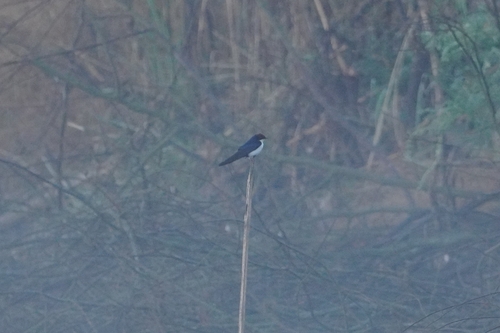
Wire-tailed Swallow
Hirundo smithii
The wire-tailed swallow is a small swallow, measuring 18 cm (7.1 in) in length. It has bright blue upperparts, bright white underparts and a chestnut cap. Immature birds lack tail wires, and have dull brown (rather than chestnut) caps. The species is named for the very long filamentous outermost tail feathers, which trail behind like two wires. The sexes are similar in appearance, but the female has shorter "wires". Juveniles have a brown crown, back and tail. The Asian form, H. s. filifera, is larger and longer-tailed than the abundant African H. s. smithii.
ID text from Wikipedia, CC BY-SA 4.0
Where you might meet both
And 25 more countries.
Learn this pair in the BeakBrain App
Photo and call practice. Coming soon to iPhone and Android.
Play today's Daily BirdPhotos and recordings are credited to their authors under the licence shown. Full profiles: Barn Swallow and Wire-tailed Swallow.