Learn what every symbol on the card means.Full credits and sources at beakbrain.com/symbols
 ForestDomed nestSmall · 33 g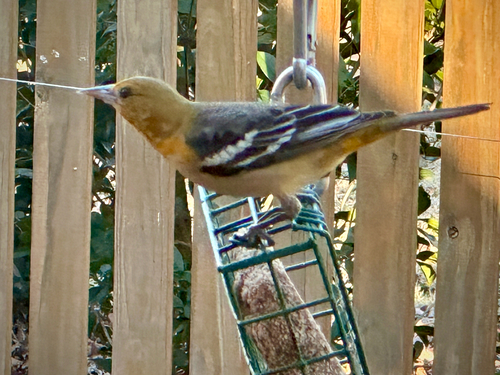
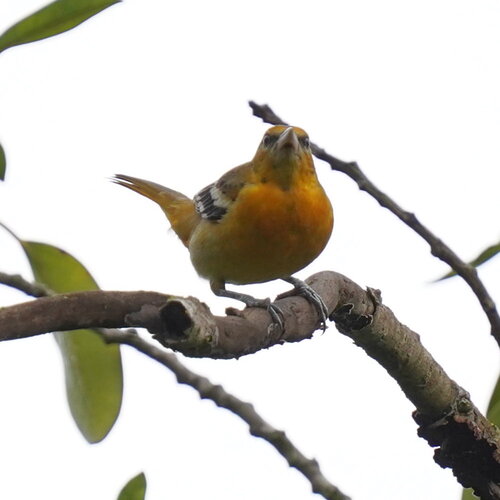


What the Baltimore Oriole sounds like


ID tip
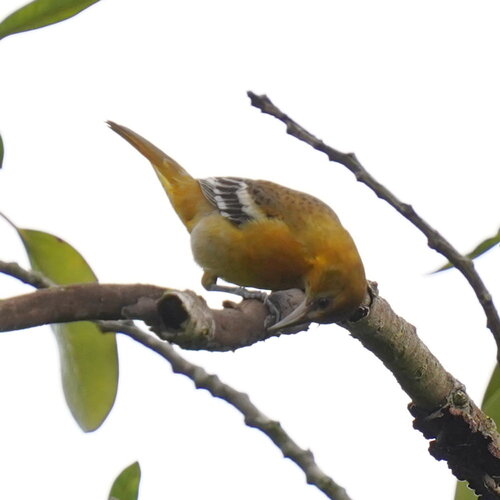
This medium-sized passerine measures 17–22 cm (6.7–8.7 in) in length and spans 23–32 cm (9.1–12.6 in) across the wings. Their build is typical of icterids, as they have a sturdy body, a longish tail, fairly long legs and a thick, pointed bill. The body weight averages 33.8 g (1.19 oz), with a range of weights from 22.3 to 42 g (0.79 to 1.48 oz). The male oriole is slightly larger than the female, although the size dimorphism is minimal by icterid standards. Adults always have white bars on the wings. Voice: The Baltimore orioles' song is a short set of recognizable, sweet whistles that sound like "tyew, pyeer, peededoo, and "teer." Calls include "veeer," which is an unusual nasal sound, a low chatter call, and two high calls which sound like "tyew-li and kleek.
Text from Wikipedia, licensed CC BY-SA 4.0.
When to see the Baltimore Oriole
One bar for each month. Filled bars are the 5 months with records; pale bars are months with none. The wide bar is May, the month with the most records.
Where to see the Baltimore Oriole
The map shades 32 countries with regular records, and 11 more in a lighter tone where the bird turns up only as a stray. Everything unshaded has no records. Countries are listed below the map.
Recorded as a rare visitor in United Kingdom, France, Netherlands, Norway, Portugal, Brazil, Chile, Iceland, Haiti, Martinique, St. Barthélemy.
About the Baltimore Oriole
The Baltimore oriole is a small icterid blackbird common in eastern North America as a migratory breeding bird. It received its name from the resemblance of the male's colors to those on the coat-of-arms of 17th-century Lord Baltimore. Observations of interbreeding between the Baltimore oriole and the western Bullock's oriole Icterus bullockii, led to both being classified as a single species, called the northern oriole, from 1973 to 1995. Research by James Rising, a professor of zoology at the University of Toronto, and others showed that the two birds actually did not interbreed significantly.
Text adapted from Wikipedia, licensed CC BY-SA 4.0.
Easily confused with
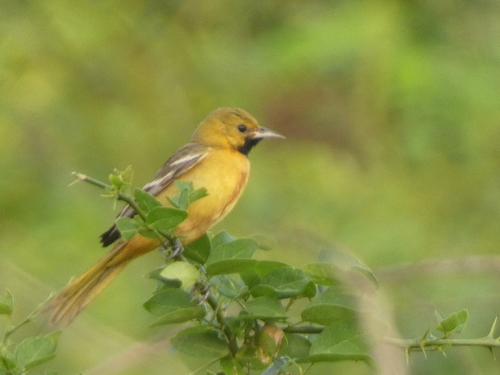 Orchard OrioleIcterus spuriusMeasurements:
Length: 5.9–7.1 in (15–18 cm)
Weight: 0.6–1.0 oz (16–28 g)
Wingspan: 9.8 in (25 cm)
The bill is pointed and black with some blue-gray at the base of the lower mandible.
Orchard OrioleIcterus spuriusMeasurements:
Length: 5.9–7.1 in (15–18 cm)
Weight: 0.6–1.0 oz (16–28 g)
Wingspan: 9.8 in (25 cm)
The bill is pointed and black with some blue-gray at the base of the lower mandible.
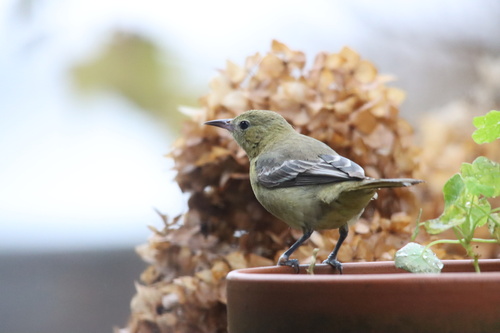 Hooded OrioleIcterus cucullatusThe hooded oriole is a medium-sized New World oriole.
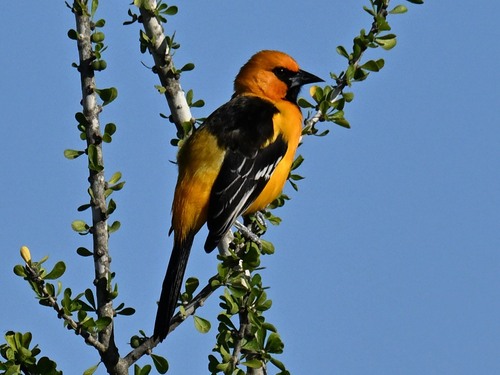 Altamira OrioleIcterus gularisBoth males and females have a black mandible and throat, as well as a black back and long black tail.
Side by side: Baltimore Oriole vs Orchard Oriole · Altamira Oriole vs Baltimore Oriole
Learn the Baltimore Oriole in the BeakBrain App
Photo and call practice. Coming soon to iPhone and Android.
Play today's Daily BirdEvery photo and recording on this page is credited to its author under the licence shown. Spotted a problem with this page, or have a better photo? Contribute.