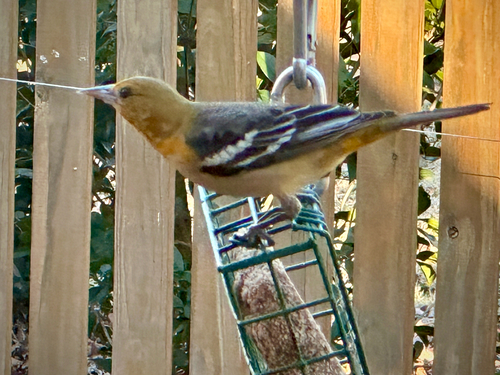
Baltimore Oriole
Icterus galbula
This medium-sized passerine measures 17–22 cm (6.7–8.7 in) in length and spans 23–32 cm (9.1–12.6 in) across the wings. Their build is typical of icterids, as they have a sturdy body, a longish tail, fairly long legs and a thick, pointed bill. The body weight averages 33.8 g (1.19 oz), with a range of weights from 22.3 to 42 g (0.79 to 1.48 oz). The male oriole is slightly larger than the female, although the size dimorphism is minimal by icterid standards. Adults always have white bars on the wings. Voice: The Baltimore orioles' song is a short set of recognizable, sweet whistles that sound like "tyew, pyeer, peededoo, and "teer." Calls include "veeer," which is an unusual nasal sound, a low chatter call, and two high calls which sound like "tyew-li and kleek.
ID text from Wikipedia, CC BY-SA 4.0

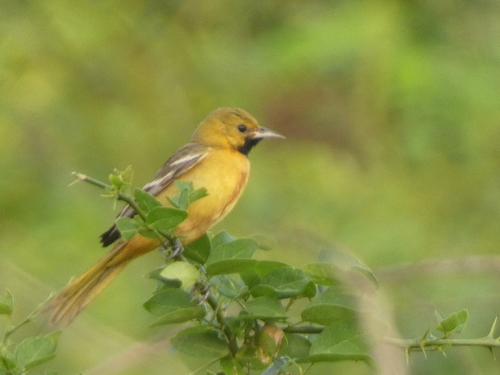
Orchard Oriole
Icterus spurius
Measurements: Length: 5.9–7.1 in (15–18 cm) Weight: 0.6–1.0 oz (16–28 g) Wingspan: 9.8 in (25 cm) The bill is pointed and black with some blue-gray at the base of the lower mandible. The adult male of the nominate subspecies has chestnut on the underparts, shoulder, and rump, with the rest of the plumage black. In the subspecies I. s. fuertesi, the chestnut is replaced with ochre. The adult female and the juvenile of both subspecies have olive-green on the upper parts and yellowish on the breast and belly. All adults have pointed bills and white wing bars.
ID text from Wikipedia, CC BY-SA 4.0

Where you might meet both
Learn this pair in the BeakBrain App
Photo and call practice. Coming soon to iPhone and Android.
Play today's Daily BirdPhotos and recordings are credited to their authors under the licence shown. Full profiles: Baltimore Oriole and Orchard Oriole.