Learn what every symbol on the card means.Full credits and sources at beakbrain.com/symbols
 WoodlandDomed nestSmall · 55 g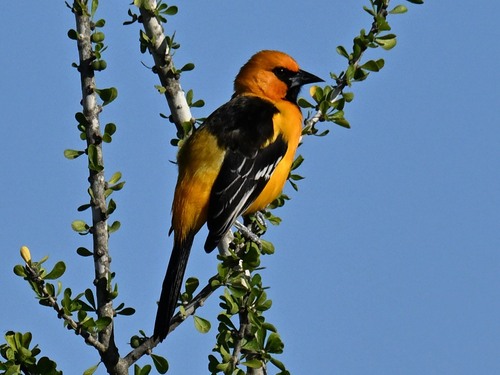


ID tip
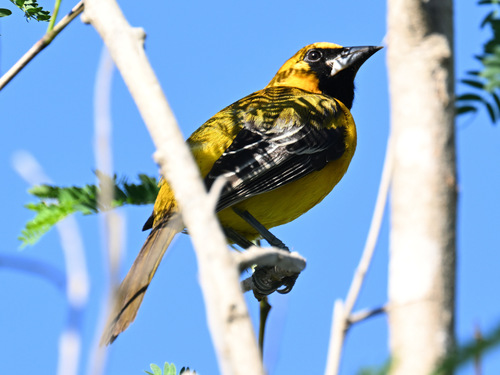
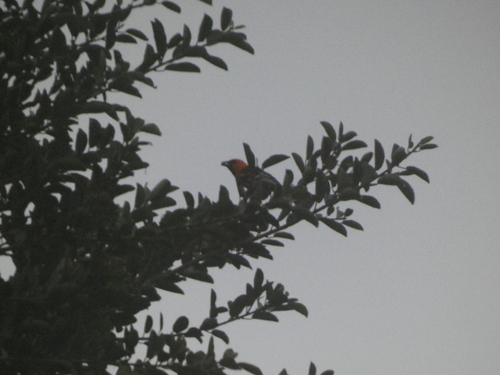
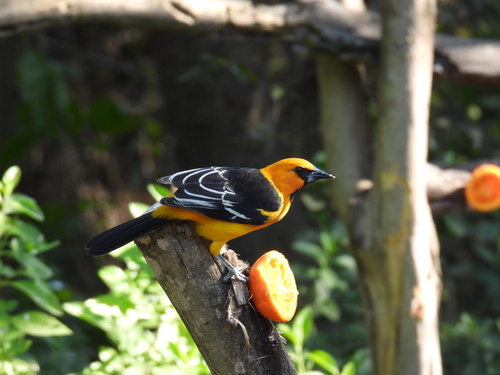
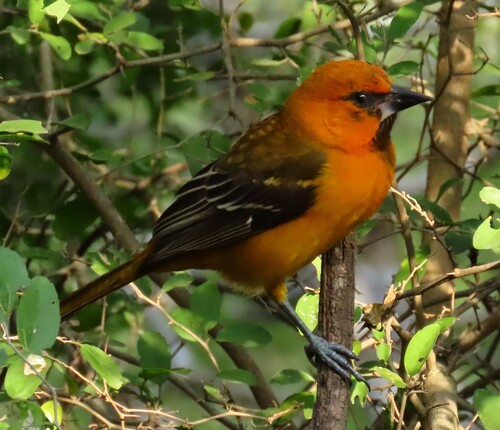
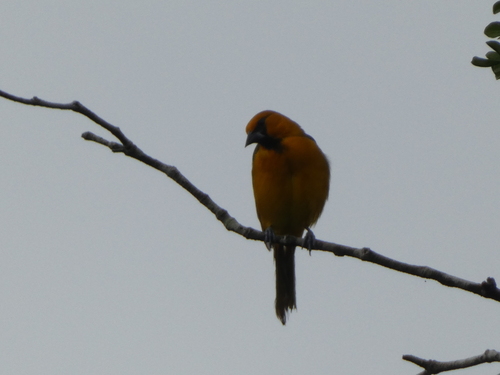
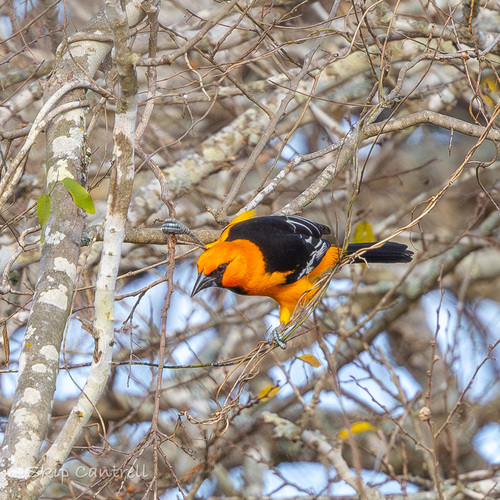
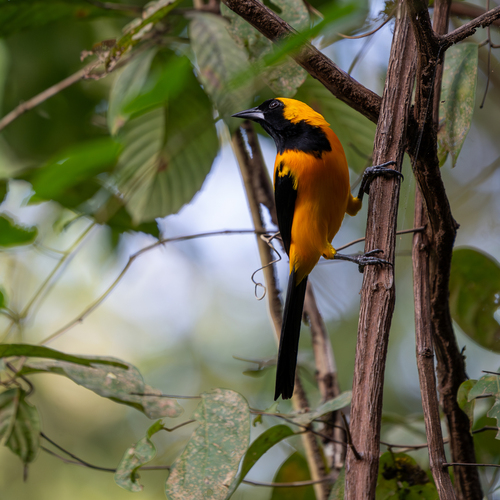
Both males and females have a black mandible and throat, as well as a black back and long black tail. Wings are black, but the remiges and rectrices (flight feathers) are fringed with white. These form a single white wing bar and white wing spots when folded. The secondary coverts form orange epaulets. The underside is almost uniformly orange or yellowish-orange. In general, immature specimens have an olive back, and a dull yellow on its head and its body. The first-year bird is similar to the adult, but it has an olive, not black, back, and yellow-olive tail. Voice: The song of the Altamira oriole is a series of clear, slow musical whistles. In contrast, the Altamira's calls are harsh whistles, rasping chatter, and nasal "ike"s.
Text from Wikipedia, licensed CC BY-SA 4.0.
When to see the Altamira Oriole
One bar for each month. Filled bars are the 9 months with records; pale bars are months with none. The wide bar is January, the month with the most records.
Where to see the Altamira Oriole
The map shades 7 countries with regular records. Everything unshaded has no records. Countries are listed below the map.
About the Altamira Oriole
The Altamira oriole is a New World oriole. The bird is widespread in subtropical lowlands of the Mexican Gulf Coast and northern Central America, the Pacific coast and inland. They have since spread to southern Texas, but this was not until 1939.
Text adapted from Wikipedia, licensed CC BY-SA 4.0.
Easily confused with
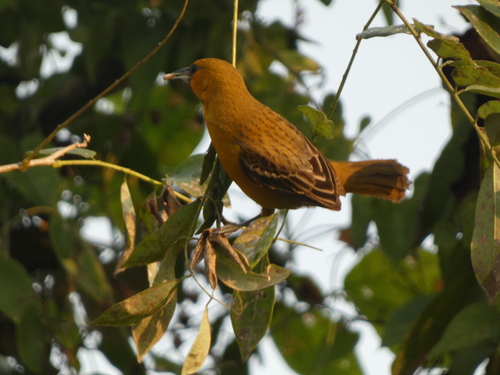 Streak-backed OrioleIcterus pustulatusThe streak-backed oriole is 19 to 21 cm (7.5 to 8.3 in) long.
 Yellow-backed OrioleIcterus chrysaterYellow-backed orioles are a yellow-bodied, sexually monomorphic species.
 Scott's OrioleIcterus parisorumScott's oriole is about 23 cm (9.1 in) long with a wingspan of 32 cm (13 in); it weighs 32 to 41 g (1.1 to 1.4 oz).
Side by side: Altamira Oriole vs Baltimore Oriole · Altamira Oriole vs Orchard Oriole · Altamira Oriole vs Streak-backed Oriole · Altamira Oriole vs Yellow-backed Oriole · Altamira Oriole vs Scott's Oriole
Learn the Altamira Oriole in the BeakBrain App
Photo and call practice. Coming soon to iPhone and Android.
Play today's Daily BirdEvery photo and recording on this page is credited to its author under the licence shown. Spotted a problem with this page, or have a better photo? Contribute.