Learn what every symbol on the card means.Full credits and sources at beakbrain.com/symbols
 GrasslandScrapeHuge · 4.2 kg


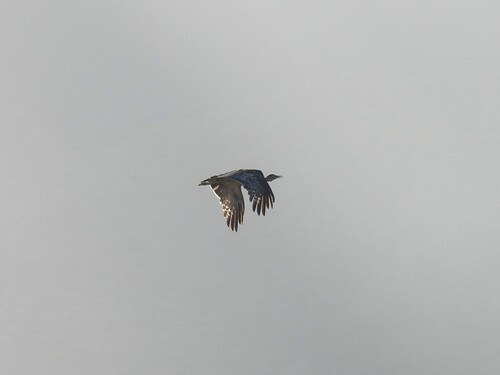
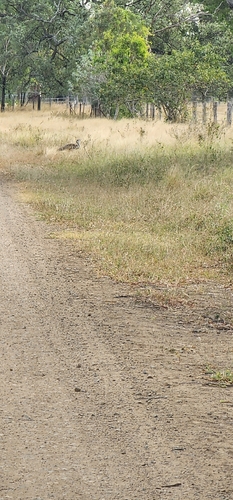
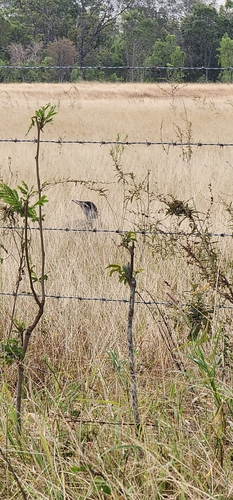

ID tip
The only Australian species of Ardeotis, a genus occurring in the African, Indian and Australasian regions, this bustard is a large terrestrial bird that resembles an American turkey in its form and behaviour. It is readily distinguished by its large size, long legs and habits while slowly striding across open plains. The general coloration of A. australis is black at the crown and nape, the long neck is pale grey at the front, and brown plumage cover the wings and upper body. The sexes are similar in appearance, females are smaller in stature, wingspan and weight than the males.
Text from Wikipedia, licensed CC BY-SA 4.0.
When to see the Australian Bustard
One bar for each month. Filled bars are the 11 months with records; pale bars are months with none. The wide bar is July, the month with the most records.
Where to see the Australian Bustard
The map shades 3 countries with regular records. Everything unshaded has no records. Countries are listed below the map.
About the Australian Bustard
The Australian bustard is a large ground-dwelling bird that is common in grassland, woodland and open agricultural country across northern Australia and southern New Guinea. It stands at about one metre high, and its wingspan is around twice that length. The species is nomadic, flying to areas when food becomes plentiful, and capable of travelling long distances. They were once widespread and common to the open plains of Australia, but became rare in regions that have been used for farming. The bustard is omnivorous, mostly consuming the fruit or seed of plants, but also eating invertebrates such as crickets, grasshoppers, smaller mammals, birds and reptiles.
Text adapted from Wikipedia, licensed CC BY-SA 4.0.
Easily confused with
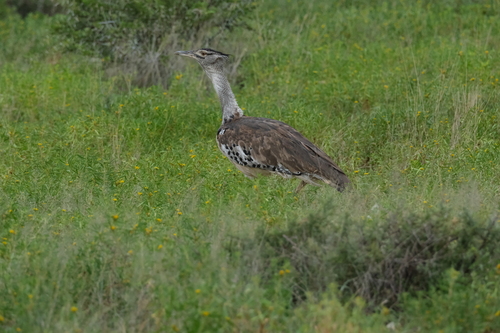 Kori BustardArdeotis koriThe kori bustard is cryptically coloured, being mostly grey and brown, finely patterned with black and white coloring.
 Arabian BustardArdeotis arabsAs in all bustards, the male Arabian bustard is much larger than the female.
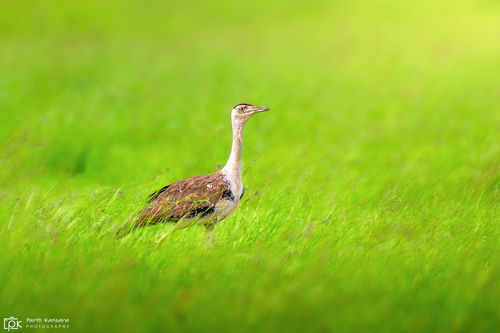 Great Indian BustardArdeotis nigricepsThe great Indian bustard is a large ground bird with a height of about one metre.
Side by side: Australian Bustard vs Kori Bustard
Learn the Australian Bustard in the BeakBrain App
Photo and call practice. Coming soon to iPhone and Android.
Play today's Daily BirdEvery photo and recording on this page is credited to its author under the licence shown. Spotted a problem with this page, or have a better photo? Contribute.