Learn what every symbol on the card means.Full credits and sources at beakbrain.com/symbols
 GrasslandScrapeHuge · 5.9 kg

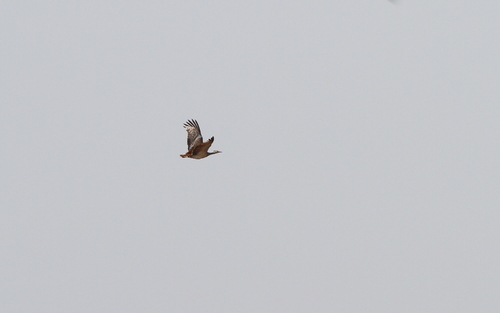

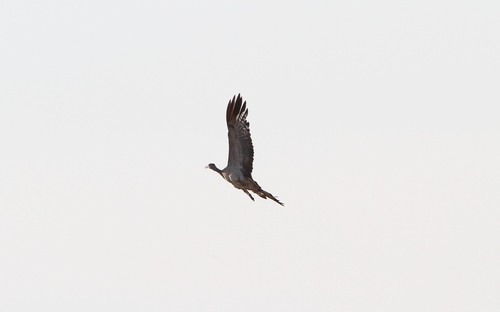
ID tip
As in all bustards, the male Arabian bustard is much larger than the female. Males have been found to weigh 5.7–10.9 kg (13–24 lb), while females weigh 4.5–7.7 kg (9.9–17.0 lb). The record-sized male Arabian bustard weighed 16.8 kg (37 lb) this makes it rank among the heaviest flying birds on the planet in terms of maximum mass. These birds stand from 70 cm (28 in) tall in females to 92 cm (36 in) tall in males. They are fairly similar in overall appearance to the kori bustard, with a brown body, gray neck and white underside, but are noticeably smaller, with a more elegant, slender build.
Text from Wikipedia, licensed CC BY-SA 4.0.
When to see the Arabian Bustard
One bar for each month. Filled bars are the 8 months with records; pale bars are months with none. The wide bar is December, the month with the most records.
Where to see the Arabian Bustard
The map shades 13 countries with regular records, and 2 more in a lighter tone where the bird turns up only as a stray. Everything unshaded has no records. Countries are listed below the map.
Recorded as a rare visitor in Mauritania, Morocco.
About the Arabian Bustard
The Arabian bustard is a species of bustard which is found across the Sahel region of Africa and south western Arabia. It is part of the large-bodied genus, Ardeotis, and, though little known, appears to be a fairly typical species in that group.
Text adapted from Wikipedia, licensed CC BY-SA 4.0.
Easily confused with
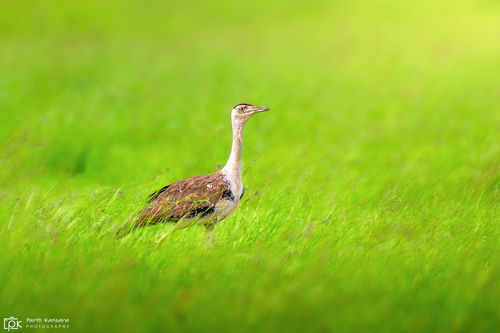 Great Indian BustardArdeotis nigricepsThe great Indian bustard is a large ground bird with a height of about one metre.
 Australian BustardArdeotis australisThe only Australian species of Ardeotis, a genus occurring in the African, Indian and Australasian regions, this bustard is a large terrestrial bird that resembles an American turkey in its form and behaviour.
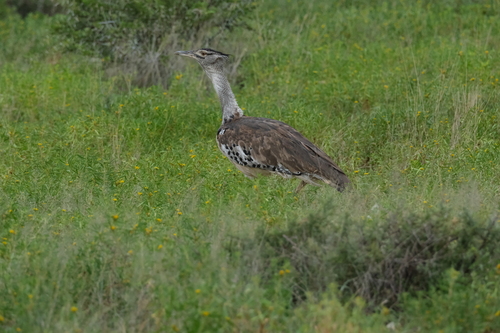 Kori BustardArdeotis koriThe kori bustard is cryptically coloured, being mostly grey and brown, finely patterned with black and white coloring.
Learn the Arabian Bustard in the BeakBrain App
Photo and call practice. Coming soon to iPhone and Android.
Play today's Daily BirdEvery photo and recording on this page is credited to its author under the licence shown. Spotted a problem with this page, or have a better photo? Contribute.