Learn what every symbol on the card means.Full credits and sources at beakbrain.com/symbols
 GrasslandScrapeHuge · 7.2 kg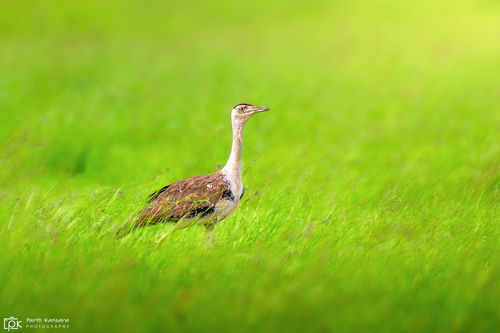


ID tip
The great Indian bustard is a large ground bird with a height of about one metre. It is unmistakable with its black cap contrasting with the pale head and neck. The body is brownish with a black patch spotted in white. The male is deep sandy buff coloured and during the breeding season has a black breast band. The crown of the head is black and crested and is puffed up by displaying males. In the female which is smaller than the male, the head and neck are not pure white and the breast band is either rudimentary, broken or absent.
Text from Wikipedia, licensed CC BY-SA 4.0.
When to see the Great Indian Bustard
One bar for each month. Filled bars are the 6 months with records; pale bars are months with none. The wide bar is November, the month with the most records.
About the Great Indian Bustard
The great Indian bustard or Indian bustard is a bustard occurring on the Indian subcontinent. It is a large bird with a horizontal body, long bare legs and is among the heaviest of the flying birds. Once common on the dry grasslands and shrubland in India, as few as 150 individuals were estimated to survive as of 2018, reduced from an estimated 250 individuals in 2011. It is critically endangered due to hunting and habitat loss. It is protected under the Indian Wild Life (Protection) Act, 1972.
Text adapted from Wikipedia, licensed CC BY-SA 4.0.
Easily confused with
 Arabian BustardArdeotis arabsAs in all bustards, the male Arabian bustard is much larger than the female.
 Australian BustardArdeotis australisThe only Australian species of Ardeotis, a genus occurring in the African, Indian and Australasian regions, this bustard is a large terrestrial bird that resembles an American turkey in its form and behaviour.
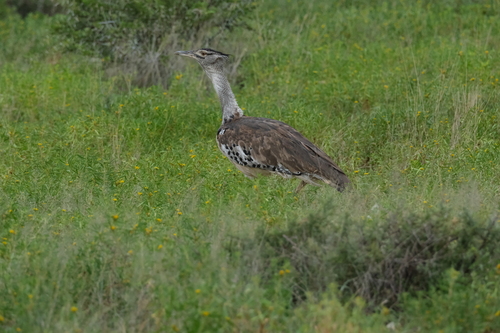 Kori BustardArdeotis koriThe kori bustard is cryptically coloured, being mostly grey and brown, finely patterned with black and white coloring.
Learn the Great Indian Bustard in the BeakBrain App
Photo and call practice. Coming soon to iPhone and Android.
Play today's Daily BirdEvery photo and recording on this page is credited to its author under the licence shown. Spotted a problem with this page, or have a better photo? Contribute.