
Australian Bustard
Ardeotis australis
The only Australian species of Ardeotis, a genus occurring in the African, Indian and Australasian regions, this bustard is a large terrestrial bird that resembles an American turkey in its form and behaviour. It is readily distinguished by its large size, long legs and habits while slowly striding across open plains. The general coloration of A. australis is black at the crown and nape, the long neck is pale grey at the front, and brown plumage cover the wings and upper body. The sexes are similar in appearance, females are smaller in stature, wingspan and weight than the males.
ID text from Wikipedia, CC BY-SA 4.0
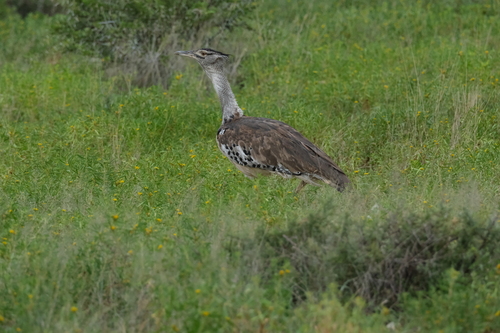
Kori Bustard
Ardeotis kori
The kori bustard is cryptically coloured, being mostly grey and brown, finely patterned with black and white coloring. The upper parts and neck are a vermiculated black and greyish-buff colour. The ventral plumage is more boldly colored, with white, black and buff. The crest on its head is blackish in coloration, with less black on the female's crest. There is a white eye stripe above the eye. The chin, throat and neck are whitish with thin, fine black barring. A black collar at the base of the hind-neck extends onto the sides of the breast. Voice: Less vocal than other bustards, the kori bustard is generally silent but, when alarmed, both sexes emit a loud growling bark. This is described as a ca-caa-ca call, repeated several times for up to 10 minutes. This call carries long distances. This call is most often given by females with young and males during agonistic encounters.
ID text from Wikipedia, CC BY-SA 4.0
Learn this pair in the BeakBrain App
Photo and call practice. Coming soon to iPhone and Android.
Play today's Daily BirdPhotos and recordings are credited to their authors under the licence shown. Full profiles: Australian Bustard and Kori Bustard.