Learn what every symbol on the card means.Full credits and sources at beakbrain.com/symbols
 WetlandPlatform nestHuge · 2.2 kg


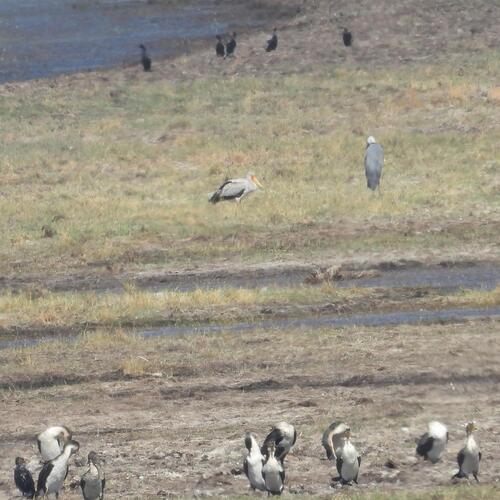
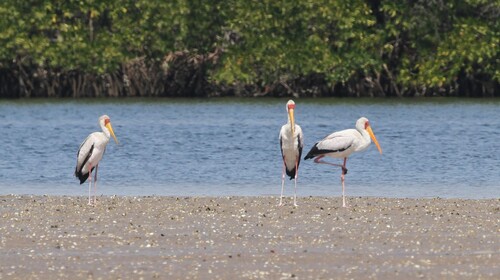
ID tip
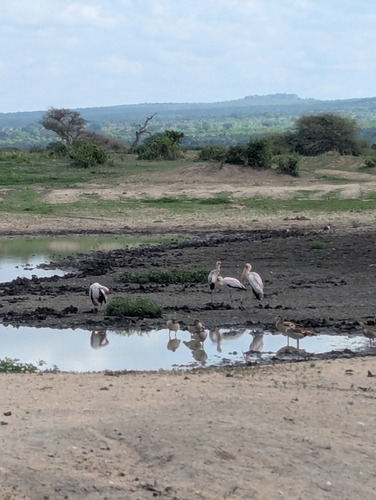
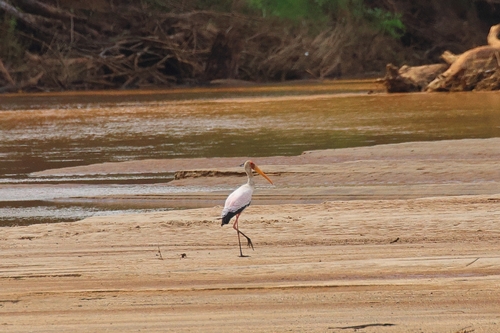
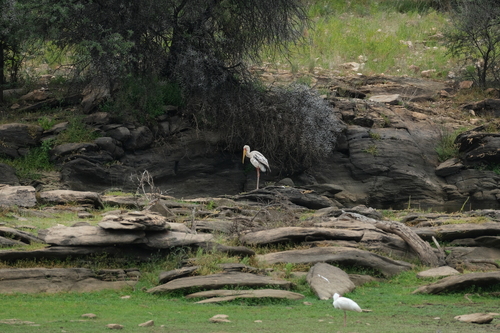
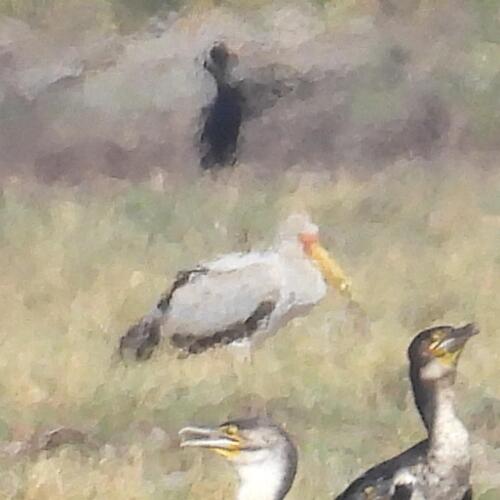
This medium-sized stork stands 90–105 cm (35–41 in) tall. Its body is white with a short black tail that is glossed green and purple when freshly moulted. The bill is deep yellow, slightly decurved at the end and with a rounder cross-section than in other stork species outside the Mycteria. Feathers extend onto the head and neck just behind the eyes, with the face and forehead being covered by deep red skin. Both sexes are similar in appearance, but the male is larger and has a slightly longer heavier bill. Males and females weigh approximately 2.3 kg (5.1 lb) and 1.9 kg (4.2 lb) respectively.
Text from Wikipedia, licensed CC BY-SA 4.0.
When to see the Yellow-billed Stork
One bar for each month, and every month is filled: this bird is recorded here in all twelve. The wide bar is November, the month with the most records.
Where to see the Yellow-billed Stork
The map shades 40 countries with regular records, and 9 more in a lighter tone where the bird turns up only as a stray. Everything unshaded has no records. Countries are listed below the map.
Recorded as a rare visitor in Spain, Germany, Türkiye, Austria, Portugal, Lesotho, Mali, Sierra Leone, Belgium.
About the Yellow-billed Stork
The yellow-billed stork is a large African stork species in the family Ciconiidae. It is widespread south of the Sahara and also occurs in Madagascar.
Text adapted from Wikipedia, licensed CC BY-SA 4.0.
Easily confused with
 Milky StorkMycteria cinereaThe milky stork is a stork species inhabiting predominantly mangroves in Southeast Asia.
 Painted StorkMycteria leucocephalaThis large stork has a heavy yellow beak with a down-curved tip that gives it a resemblance to an ibis.
 Wood StorkMycteria americanaThe adult wood stork is a large bird which stands 83 to 115 cm (33–45 in) tall with a wingspan of 140 to 180 cm (55–71 in).
Side by side: Wood Stork vs Yellow-billed Stork · Painted Stork vs Yellow-billed Stork
Learn the Yellow-billed Stork in the BeakBrain App
Photo and call practice. Coming soon to iPhone and Android.
Play today's Daily BirdEvery photo and recording on this page is credited to its author under the licence shown. Spotted a problem with this page, or have a better photo? Contribute.