Learn what every symbol on the card means.Full credits and sources at beakbrain.com/symbols
 WetlandPlatform nestHuge · 3.2 kg

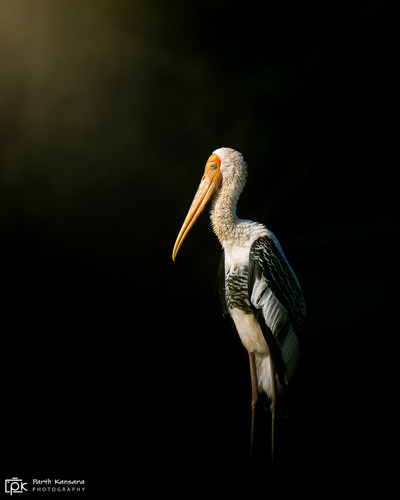
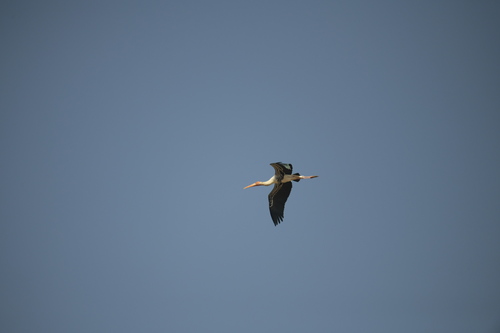
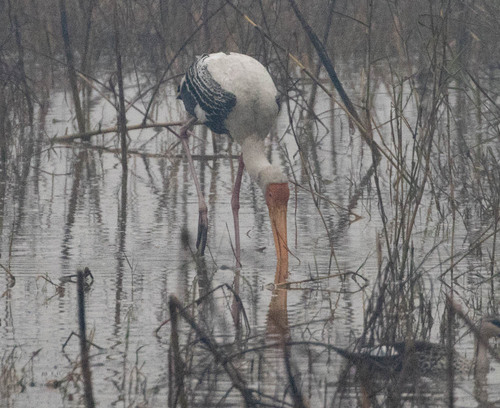
What the Painted Stork sounds like

ID tip
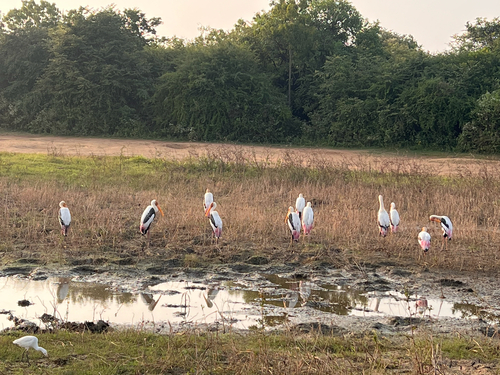
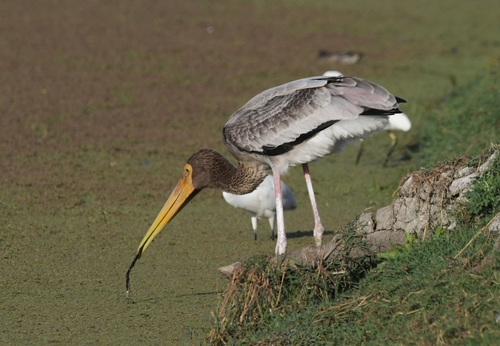
This large stork has a heavy yellow beak with a down-curved tip that gives it a resemblance to an ibis. The head of the adult is bare and orange or reddish in colour. The long tertials are tipped in bright pink and at rest they extend over the back and rump. There is a distinctive black breast band with white scaly markings. The band continues into the under-wing coverts and the white tips of the black coverts give it the appearance of white stripes running across the under-wing lining. The rest of the body is whitish in adults and the primaries and secondaries are black with a greenish gloss.
Text from Wikipedia, licensed CC BY-SA 4.0.
When to see the Painted Stork
One bar for each month. Filled bars are the 10 months with records; pale bars are months with none. The wide bar is January, the month with the most records.
Where to see the Painted Stork
The map shades 12 countries with regular records, and 1 more in a lighter tone where the bird turns up only as a stray. Everything unshaded has no records. Countries are listed below the map.
Recorded as a rare visitor in United Arab Emirates.
About the Painted Stork
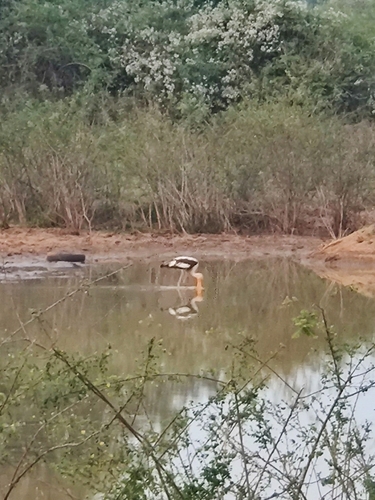
The painted stork is a large wader in the stork family. It is found in the wetlands of the plains of tropical Asia south of the Himalayas in the Indian subcontinent and extending into Southeast Asia. Their distinctive pink tertial feathers of the adults give them their name. They forage in flocks in shallow waters along rivers or lakes. They immerse their half open beaks in water and sweep them from side to side and snap up their prey of small fish that are sensed by touch. As they wade along they also stir the water with their feet to flush hiding fish. They nest colonially in trees, often along with other waterbirds.
Text adapted from Wikipedia, licensed CC BY-SA 4.0.
Easily confused with
 Yellow-billed StorkMycteria ibisThis medium-sized stork stands 90–105 cm (35–41 in) tall.
 Milky StorkMycteria cinereaThe milky stork is a stork species inhabiting predominantly mangroves in Southeast Asia.
 Wood StorkMycteria americanaThe adult wood stork is a large bird which stands 83 to 115 cm (33–45 in) tall with a wingspan of 140 to 180 cm (55–71 in).
Side by side: Painted Stork vs Wood Stork · Painted Stork vs Yellow-billed Stork
Learn the Painted Stork in the BeakBrain App
Photo and call practice. Coming soon to iPhone and Android.
Play today's Daily BirdEvery photo and recording on this page is credited to its author under the licence shown. Spotted a problem with this page, or have a better photo? Contribute.