Learn what every symbol on the card means.Full credits and sources at beakbrain.com/symbols
 RiverineScrapeSmall · 58 g



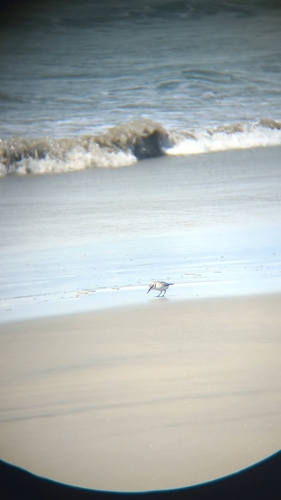

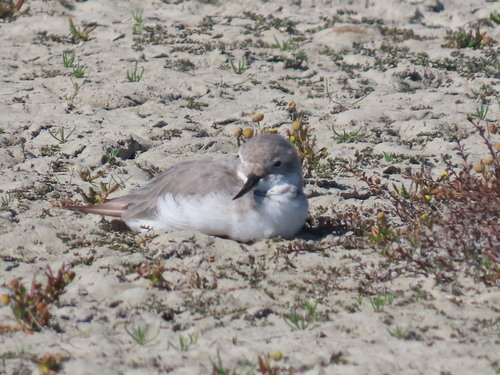
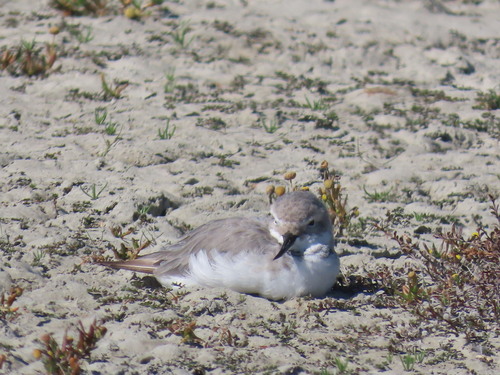
ID tip
The wrybill is a small, plump plover, measuring 20 to 21 cm (7.9–8.3 in) in length and weighing between 43 and 71 g (1.5–2.5 oz). The plumage is slightly sexually dimorphic. The male has a white forehead and pale grey crown, nape, back, wings and tail and a white throat, breast, belly and rump, with a thin black band across the breast. This band is thinner in the female, and much less distinct in both sexes in the non-breeding season. The other difference between the sexes is a small black bar between the white forehead and the grey crown, which is present in the males but not the females.
Text from Wikipedia, licensed CC BY-SA 4.0.
When to see the Wrybill
One bar for each month, and every month is filled: this bird is recorded here in all twelve. The wide bar is January, the month with the most records.
Where to see the Wrybill
The map shades 1 country with regular records. Everything unshaded has no records. Countries are listed below the map.
About the Wrybill
The wrybill or wrybill plover is a species of plover endemic to New Zealand. It is the only species of bird in the world with a beak that is bent sideways in one direction, always to the right. A 2015 study found it to be within the Charadrius clade, with other New Zealand plovers its closest relatives; the nearest being the New Zealand dotterel or New Zealand plover, and then the double-banded plover or banded dotterel.
Text adapted from Wikipedia, licensed CC BY-SA 4.0.
Easily confused with
 Oriental PloverAnarhynchus veredusAdult male in breeding plumage: white face, throat and fore-crown; grey-brown hind-crown, hind-neck and back; belly white, demarcated with narrow black band and then broad chestnut breast band merging into white throat.
 Caspian PloverAnarhynchus asiaticusThis plover is slightly larger than ringed plover, and it recalls greater sandplover and lesser sandplover in appearance.
 White-fronted PloverAnarhynchus marginatusThe average white-fronted plover weighs approximately 45-50 g, and the two sexes differ slightly in plumage coloration.
Side by side: Kentish Plover vs Wrybill · Greater Sand Plover vs Wrybill · Oriental Plover vs Wrybill · Caspian Plover vs Wrybill
Learn the Wrybill in the BeakBrain App
Photo and call practice. Coming soon to iPhone and Android.
Play today's Daily BirdEvery photo and recording on this page is credited to its author under the licence shown. Spotted a problem with this page, or have a better photo? Contribute.