Learn what every symbol on the card means.Full credits and sources at beakbrain.com/symbols


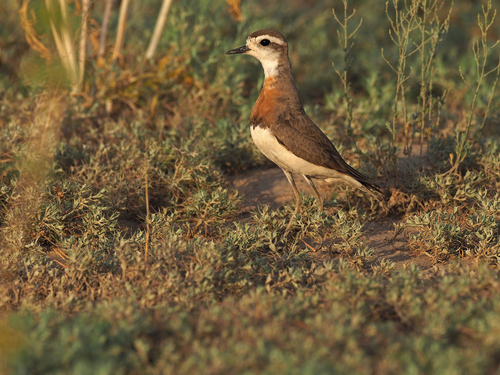
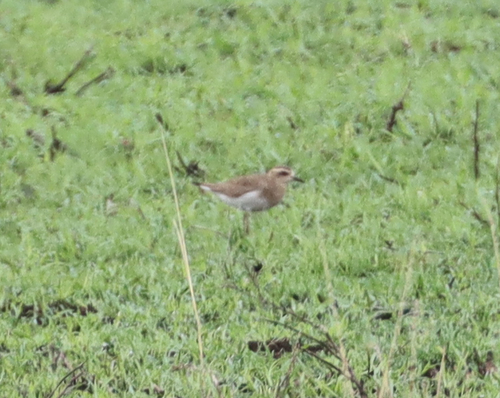
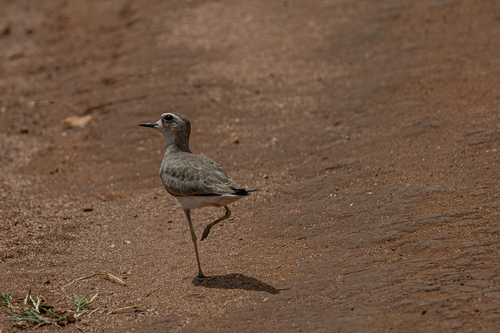
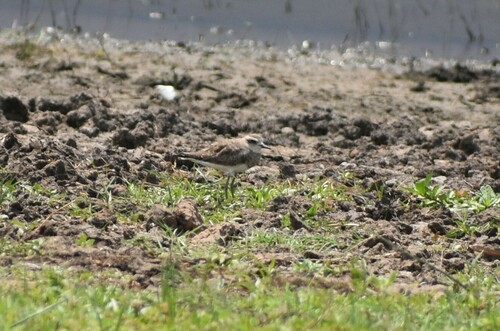
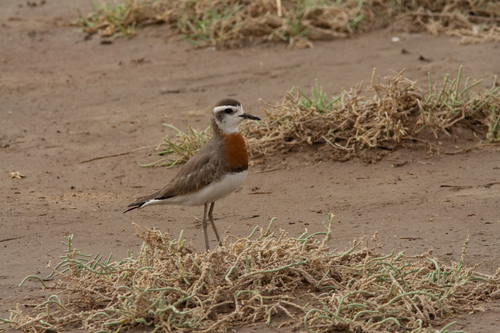
ID tip
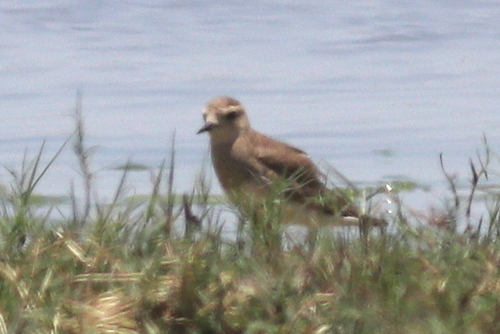
This plover is slightly larger than ringed plover, and it recalls greater sandplover and lesser sandplover in appearance. It is slimmer and longer-legged than the sandplovers, and has a much stronger white supercilium, and a long thin bill. It also lacks white tail sides and a weak wing bar. Summer males have grey-brown backs and a white face and belly. The breast is chestnut, bordered black below. Other plumages have a grey-brown breast band, although the summer female may show a hint of chestnut. The call is a sharp chip.
Text from Wikipedia, licensed CC BY-SA 4.0.
When to see the Caspian Plover
One bar for each month. Filled bars are the 9 months with records; pale bars are months with none. The wide bar is March, the month with the most records.
Where to see the Caspian Plover
The map shades 34 countries with regular records, and 8 more in a lighter tone where the bird turns up only as a stray. Everything unshaded has no records. Countries are listed below the map.
Recorded as a rare visitor in Netherlands, Norway, France, Finland, Sri Lanka, United Kingdom, Jordan, Hungary.
About the Caspian Plover
The Caspian plover is a wader in the plover family of birds. The specific asiaticus is Latin and means "Asian", although in binomials it usually means the type locality was India.
Text adapted from Wikipedia, licensed CC BY-SA 4.0.
Easily confused with
 Oriental PloverAnarhynchus veredusAdult male in breeding plumage: white face, throat and fore-crown; grey-brown hind-crown, hind-neck and back; belly white, demarcated with narrow black band and then broad chestnut breast band merging into white throat.
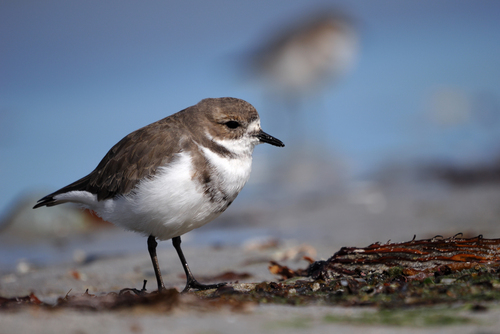 Two-banded PloverAnarhynchus falklandicusThe two-banded plover is 17 to 19 cm (6.7 to 7.5 in) long and weighs 62 to 72 g (2.2 to 2.5 oz).
 White-fronted PloverAnarhynchus marginatusThe average white-fronted plover weighs approximately 45-50 g, and the two sexes differ slightly in plumage coloration.
Side by side: Caspian Plover vs Greater Sand Plover · Caspian Plover vs Wrybill · Caspian Plover vs Oriental Plover
Learn the Caspian Plover in the BeakBrain App
Photo and call practice. Coming soon to iPhone and Android.
Play today's Daily BirdEvery photo and recording on this page is credited to its author under the licence shown. Spotted a problem with this page, or have a better photo? Contribute.