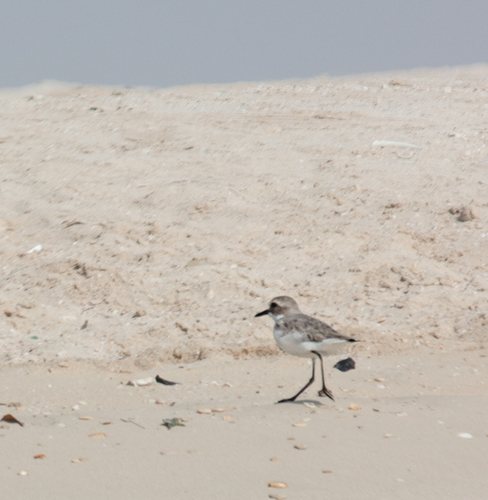
Greater Sand Plover
Anarhynchus leschenaultii
This chunky plover is 19–22 cm long, slightly larger than a common ringed plover, and is conspicuously long-legged and thick-billed. Breeding males have sandy buff backs and white underparts. The breast, forehead and nape are variably orange in summer, and there is a black eye mask in summer. The female is duller and greyer, and winter and juvenile birds are browner, apart from a hint of rufous on the head. The legs are greenish-yellow and the bill black. In all plumages, it is very similar to its close relatives Siberian sand plover A. mongolus and Tibetan sand plover A. atrifrons.
ID text from Wikipedia, CC BY-SA 4.0

Wrybill
Anarhynchus frontalis
The wrybill is a small, plump plover, measuring 20 to 21 cm (7.9–8.3 in) in length and weighing between 43 and 71 g (1.5–2.5 oz). The plumage is slightly sexually dimorphic. The male has a white forehead and pale grey crown, nape, back, wings and tail and a white throat, breast, belly and rump, with a thin black band across the breast. This band is thinner in the female, and much less distinct in both sexes in the non-breeding season. The other difference between the sexes is a small black bar between the white forehead and the grey crown, which is present in the males but not the females.
ID text from Wikipedia, CC BY-SA 4.0
Where you might meet both
Learn this pair in the BeakBrain App
Photo and call practice. Coming soon to iPhone and Android.
Play today's Daily BirdPhotos and recordings are credited to their authors under the licence shown. Full profiles: Greater Sand Plover and Wrybill.