Learn what every symbol on the card means.Full credits and sources at beakbrain.com/symbols
 ForestCup nestTiny · 14 g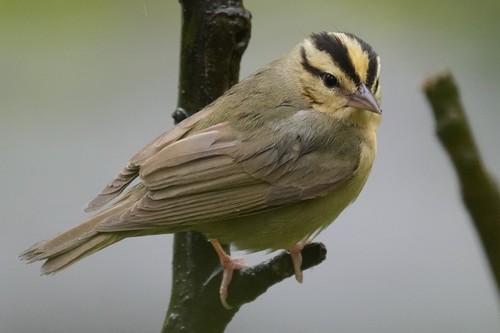
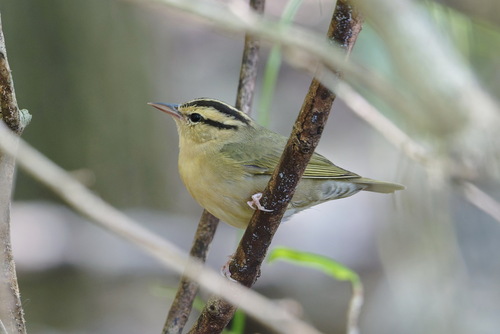
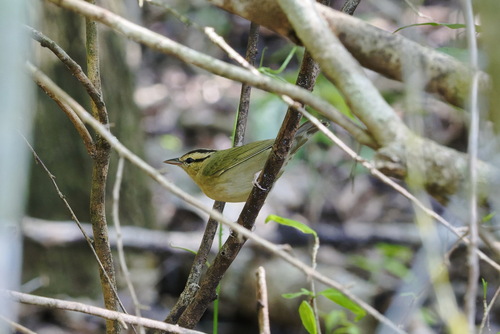
ID tip
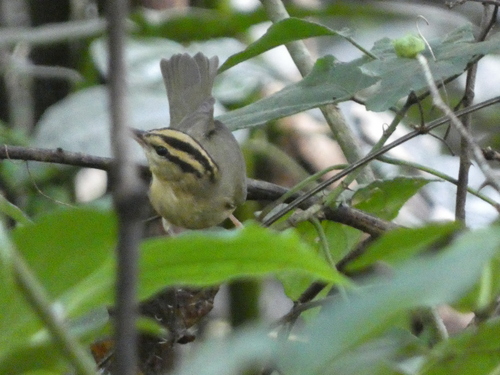
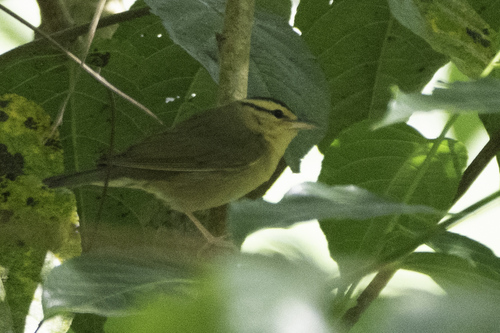
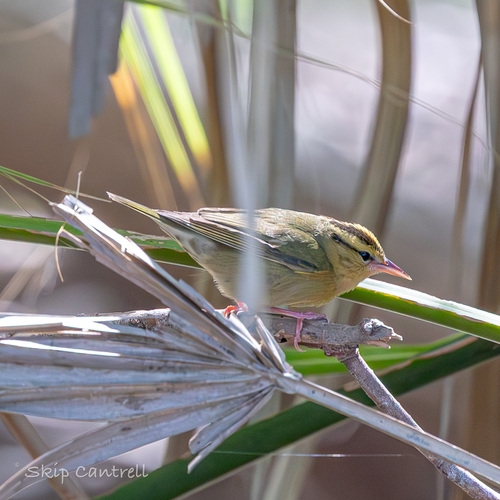
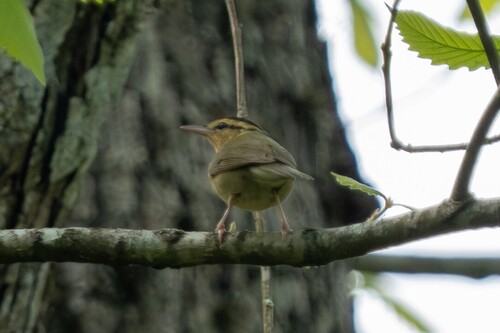
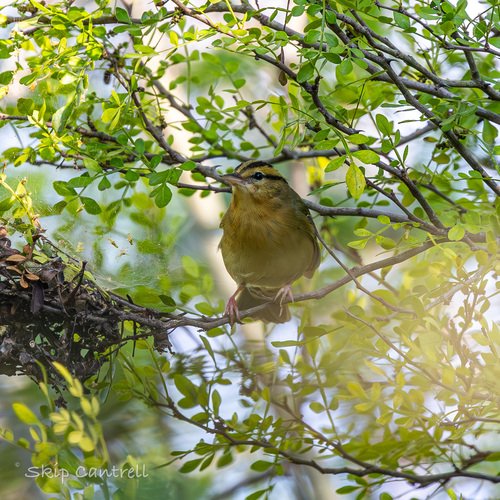
The worm-eating warbler is a small New World warbler. It is around 13 cm (5.1 in) in length and weighs 11.8–17.4 g (0.42–0.61 oz). It is relatively plain with olive-brown upperparts and light-coloured underparts, but has black and light brown stripes on its head. It has a slim pointed bill and pink legs. In immature birds, the head stripes are brownish. The male's song is a short high-pitched trill. This bird's call is a chip or tseet. Worm-eating warblers are sexually monomorphic.
Text from Wikipedia, licensed CC BY-SA 4.0.
When to see the Worm-eating Warbler
One bar for each month. Filled bars are the 5 months with records; pale bars are months with none. The wide bar is May, the month with the most records.
Where to see the Worm-eating Warbler
The map shades 22 countries with regular records, and 4 more in a lighter tone where the bird turns up only as a stray. Everything unshaded has no records. Countries are listed below the map.
Recorded as a rare visitor in St. Martin, Caribbean Netherlands, St. Barthélemy, St. Pierre & Miquelon.
About the Worm-eating Warbler
The worm-eating warbler is a small New World warbler that breeds in the Eastern United States and migrates to southern Mexico, the Caribbean, and Central America for the winter. It is the only species in the genus Helmitheros.
Text adapted from Wikipedia, licensed CC BY-SA 4.0.
Easily confused with
 Mourning WarblerGeothlypis philadelphiaMourning warblers are small songbird with yellow underparts, olive-green upperparts, a thin pointed bill and pink legs.
 Kentucky WarblerGeothlypis formosaAdult Kentucky warblers are mostly an olive-green in color on their back and nape, and a brilliant yellow below from their throat to their belly.
 Slate-throated WhitestartMyioborus miniatusThe slate-throated whitestart is a long-tailed warbler measuring 12 cm (4.7 in) long.
Side by side: Mourning Warbler vs Worm-eating Warbler · Slate-throated Whitestart vs Worm-eating Warbler · Kentucky Warbler vs Worm-eating Warbler
Learn the Worm-eating Warbler in the BeakBrain App
Photo and call practice. Coming soon to iPhone and Android.
Play today's Daily BirdEvery photo and recording on this page is credited to its author under the licence shown. Spotted a problem with this page, or have a better photo? Contribute.