
Mourning Warbler
Geothlypis philadelphia
Mourning warblers are small songbird with yellow underparts, olive-green upperparts, a thin pointed bill and pink legs. Adult males have a gray hood, black lores and a black patch on the throat and breast. In the fall, this pattern becomes less bright and harder to distinguish from similar species; however they never have a broken eye ring. Females and immatures are gray-brown on the head with an incomplete eye-ring. They have a yellow-gray throat with a brown or olive tint to their breast. Both sexes can range from 10 to 15 cm (3.9–5.9 in) in length and 11–13 g (0.4–0.5 oz) in weight. Voice: The song of this bird is a bright repetitive warble. The warble consists of rolling phrases that sound that typically lower in volume at the end and can sound like "chirry, chirry, chirry, chorry, chorry." The call is a sharp chip. There are usually two different pitched calls, with one higher than the harsh chip.
ID text from Wikipedia, CC BY-SA 4.0

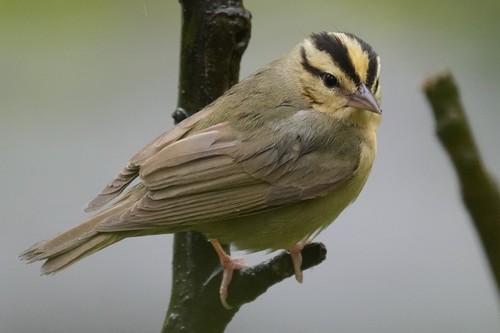
Worm-eating Warbler
Helmitheros vermivorum
The worm-eating warbler is a small New World warbler. It is around 13 cm (5.1 in) in length and weighs 11.8–17.4 g (0.42–0.61 oz). It is relatively plain with olive-brown upperparts and light-coloured underparts, but has black and light brown stripes on its head. It has a slim pointed bill and pink legs. In immature birds, the head stripes are brownish. The male's song is a short high-pitched trill. This bird's call is a chip or tseet. Worm-eating warblers are sexually monomorphic.
ID text from Wikipedia, CC BY-SA 4.0
Where you might meet both
Learn this pair in the BeakBrain App
Photo and call practice. Coming soon to iPhone and Android.
Play today's Daily BirdPhotos and recordings are credited to their authors under the licence shown. Full profiles: Mourning Warbler and Worm-eating Warbler.