Learn what every symbol on the card means.Full credits and sources at beakbrain.com/symbols
 ForestCup nestTiny · 12 g


What the Mourning Warbler sounds like


ID tip
Mourning warblers are small songbird with yellow underparts, olive-green upperparts, a thin pointed bill and pink legs. Adult males have a gray hood, black lores and a black patch on the throat and breast. In the fall, this pattern becomes less bright and harder to distinguish from similar species; however they never have a broken eye ring. Females and immatures are gray-brown on the head with an incomplete eye-ring. They have a yellow-gray throat with a brown or olive tint to their breast. Both sexes can range from 10 to 15 cm (3.9–5.9 in) in length and 11–13 g (0.4–0.5 oz) in weight. Voice: The song of this bird is a bright repetitive warble. The warble consists of rolling phrases that sound that typically lower in volume at the end and can sound like "chirry, chirry, chirry, chorry, chorry." The call is a sharp chip. There are usually two different pitched calls, with one higher than the harsh chip.
Text from Wikipedia, licensed CC BY-SA 4.0.
When to see the Mourning Warbler
One bar for each month. Filled bars are the 5 months with records; pale bars are months with none. The wide bar is May, the month with the most records.
Where to see the Mourning Warbler
The map shades 16 countries with regular records, and 5 more in a lighter tone where the bird turns up only as a stray. Everything unshaded has no records. Countries are listed below the map.
Recorded as a rare visitor in Puerto Rico, Portugal, Curaçao, Aruba, Jamaica.
About the Mourning Warbler
The mourning warbler is a small songbird of the New World warbler family. Mourning warblers are neotropical migrants native to eastern and central North America and wintering in Central and South America. They tend to be found in dense second growth forests. They are very similar to the MacGillivray's warbler in appearance, especially in females and immature birds, but their breeding range does not overlap into the west.
Text adapted from Wikipedia, licensed CC BY-SA 4.0.
Easily confused with
 Kentucky WarblerGeothlypis formosaAdult Kentucky warblers are mostly an olive-green in color on their back and nape, and a brilliant yellow below from their throat to their belly.
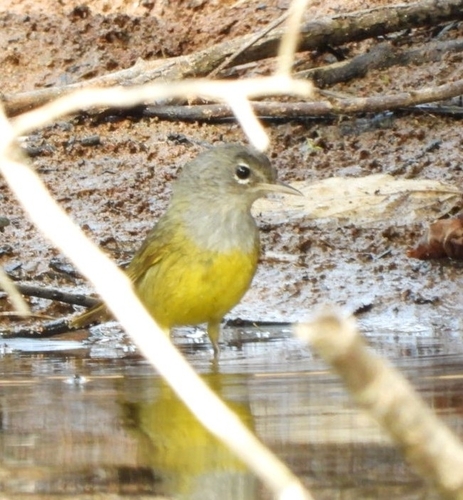 MacGillivray's WarblerGeothlypis tolmieiMacGillivray's warbler is 10 to 15 cm (3.9 to 5.9 in) long, weighs 9 to 13 g (0.32 to 0.46 oz), and has a wingspan of 19 cm (7.5 in).
 Southern YellowthroatGeothlypis velataThe southern yellowthroat is 13 to 14.3 cm (5.1 to 5.6 in) long and weighs 11 to 17 g (0.39 to 0.60 oz).
Side by side: Common Yellowthroat vs Mourning Warbler · MacGillivray's Warbler vs Mourning Warbler · Mourning Warbler vs Worm-eating Warbler · Kentucky Warbler vs Mourning Warbler · Mourning Warbler vs Southern Yellowthroat
Learn the Mourning Warbler in the BeakBrain App
Photo and call practice. Coming soon to iPhone and Android.
Play today's Daily BirdEvery photo and recording on this page is credited to its author under the licence shown. Spotted a problem with this page, or have a better photo? Contribute.