Learn what every symbol on the card means.Full credits and sources at beakbrain.com/symbols
 GrasslandCavity nestSmall · 26 g


What the White-throated Bee-eater sounds like

ID tip
This species, like other bee-eaters, is a richly coloured, slender bird. It is predominantly green, but its face and throat are white with a black crown, eye stripe, and neckband. The underparts are pale green shading to blue on the breast. The eye is red and the beak is black. The white-throated bee-eater can reach a length of 19–21 cm, excluding the two very elongated central tail feathers, which can exceed an additional length of 12 cm. They weigh between 20 and 28 grams. Sexes are alike, except that the male has longer tail feathers. The call is similar to European bee-eater.
Text from Wikipedia, licensed CC BY-SA 4.0.
When to see the White-throated Bee-eater
One bar for each month. Filled bars are the 10 months with records; pale bars are months with none. The wide bar is November, the month with the most records.
Where to see the White-throated Bee-eater
The map shades 35 countries with regular records, and 5 more in a lighter tone where the bird turns up only as a stray. Everything unshaded has no records. Countries are listed below the map.
Recorded as a rare visitor in South Africa, Angola, Eritrea, Zambia, United Arab Emirates.
About the White-throated Bee-eater
The white-throated bee-eater is a species of bee-eater that breeds in semi-desert along the southern edge of the Sahara. The white-throated bee-eater is migratory, wintering in a completely different habitat in the equatorial rain forests of Africa from southern Senegal to Uganda.
Text adapted from Wikipedia, licensed CC BY-SA 4.0.
Easily confused with
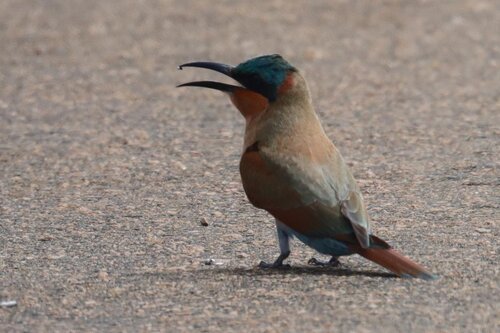 Southern Carmine Bee-eaterMerops nubicoidesThis species, like other bee-eaters, is richly coloured and is predominantly carmine in colouration, but the crown and undertail are blue.
 Cinnamon-chested Bee-eaterMerops oreobatesThe species measures 22 centimetres (8.7 in) in length and weighs 17–38 grams (0.60–1.34 oz).
 Swallow-tailed Bee-eaterMerops hirundineusLike other bee-eaters, this is a richly coloured, slender bird.
Side by side: Blue-throated Bee-eater vs White-throated Bee-eater · Swallow-tailed Bee-eater vs White-throated Bee-eater · Southern Carmine Bee-eater vs White-throated Bee-eater · Cinnamon-chested Bee-eater vs White-throated Bee-eater
Learn the White-throated Bee-eater in the BeakBrain App
Photo and call practice. Coming soon to iPhone and Android.
Play today's Daily BirdEvery photo and recording on this page is credited to its author under the licence shown. Spotted a problem with this page, or have a better photo? Contribute.