Learn what every symbol on the card means.Full credits and sources at beakbrain.com/symbols
 ShrublandCavity nestSmall · 22 g


ID tip
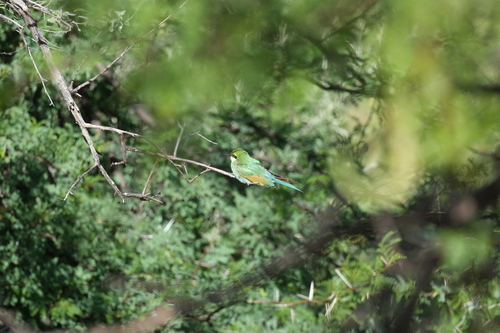
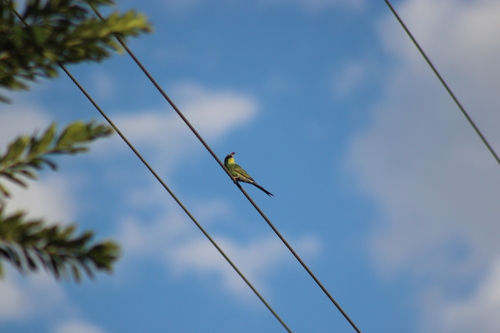
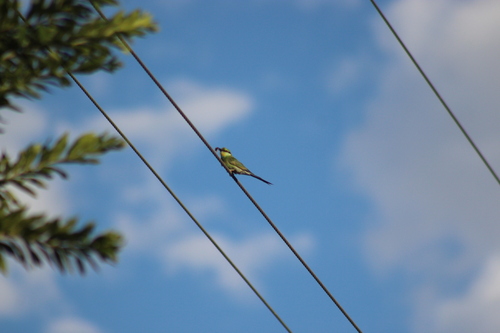
Like other bee-eaters, this is a richly coloured, slender bird. Its colours and readily visible forked tail make it unmistakable. It is mainly green with a yellow throat, blue gorget and black eye stripe and beak. Swallow-tailed bee-eaters can reach a length of 20–22 cm, including the long forked green or blue feathers. Sexes are alike.
Text from Wikipedia, licensed CC BY-SA 4.0.
When to see the Swallow-tailed Bee-eater
One bar for each month, and every month is filled: this bird is recorded here in all twelve. The wide bar is November, the month with the most records.
Where to see the Swallow-tailed Bee-eater
The map shades 24 countries with regular records, and 2 more in a lighter tone where the bird turns up only as a stray. Everything unshaded has no records. Countries are listed below the map.
Recorded as a rare visitor in Eswatini, South Sudan.
About the Swallow-tailed Bee-eater
The swallow-tailed bee-eater is a species of bee-eater native to sub-Saharan Africa. It feeds predominantly on insects, especially bees and their relatives, which are caught in flight from an open perch. Its vivid colors and forked tail are distinctive.
Text adapted from Wikipedia, licensed CC BY-SA 4.0.
Easily confused with
 Blue-throated Bee-eaterMerops viridisAdult blue-throated bee-eaters are around 21 cm long, excluding the elongated central tail feathers, which are an additional 9 cm, and a weight of around 34–41 grams.
 White-throated Bee-eaterMerops albicollisThis species, like other bee-eaters, is a richly coloured, slender bird.
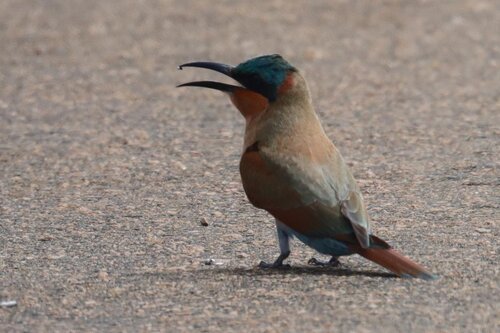 Southern Carmine Bee-eaterMerops nubicoidesThis species, like other bee-eaters, is richly coloured and is predominantly carmine in colouration, but the crown and undertail are blue.
Side by side: Arabian Green Bee-eater vs Swallow-tailed Bee-eater · Blue-throated Bee-eater vs Swallow-tailed Bee-eater · Swallow-tailed Bee-eater vs White-throated Bee-eater · Southern Carmine Bee-eater vs Swallow-tailed Bee-eater
Learn the Swallow-tailed Bee-eater in the BeakBrain App
Photo and call practice. Coming soon to iPhone and Android.
Play today's Daily BirdEvery photo and recording on this page is credited to its author under the licence shown. Spotted a problem with this page, or have a better photo? Contribute.