Learn what every symbol on the card means.Full credits and sources at beakbrain.com/symbols
 ForestPlatform nestLarge · 480 g

ID tip
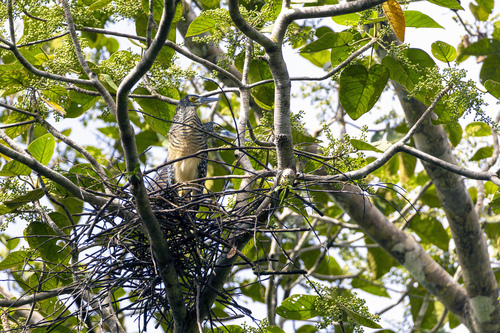
The length is 54–56 cm (21–22 in). The male is mostly blackish-brown. The neck-sides are chestnut. The lores are yellow, and the beak is black. The eyes are yellow-orange. The head and nape are blackish. The postocular stripes and throat are white. The underparts are brown, with white streaks. The tarsi are green. The female is similar to the male, but its head and neck are less distinctly patterned. The female also has whitish streaks on its back and wings. The juvenile is similar to the female, but has a browner plumage and buff spots.
Text from Wikipedia, licensed CC BY-SA 4.0.
When to see the White-eared Night Heron
One bar for each month. Filled bars are the 10 months with records; pale bars are months with none. The wide bar is May, the month with the most records.
Where to see the White-eared Night Heron
The map shades 3 countries with regular records. Everything unshaded has no records. Countries are listed below the map.
About the White-eared Night Heron
The white-eared night heron is a species of heron in the family Ardeidae. It was once thought to be only found in southern China and in northern Vietnam. However, its range is actually significantly larger as in the 2010s and 2020s has been recently discovered in Cambodia, India and Bangladesh.
Text adapted from Wikipedia, licensed CC BY-SA 4.0.
Easily confused with
 Forest BitternZonerodius heliosylusThe forest bittern is a bird indigenous to New Guinea.
 Medium EgretArdea intermediaThe medium egret, as its scientific name implies, is intermediate in size between the great egret and smaller white egrets like the little egret and cattle egret, though nearer to little than great.
 Yellow-billed EgretArdea brachyrhynchaThe yellow-billed egret has a length of 61 to 69 cm (24 to 27 in) and is white, resembling the great egret (A. alba) but differs in having a smaller bill and a gape which does not extend beyond the eye.
Learn the White-eared Night Heron in the BeakBrain App
Photo and call practice. Coming soon to iPhone and Android.
Play today's Daily BirdEvery photo and recording on this page is credited to its author under the licence shown. Spotted a problem with this page, or have a better photo? Contribute.