Learn what every symbol on the card means.Full credits and sources at beakbrain.com/symbols
 WetlandPlatform nestLarge · 459 g


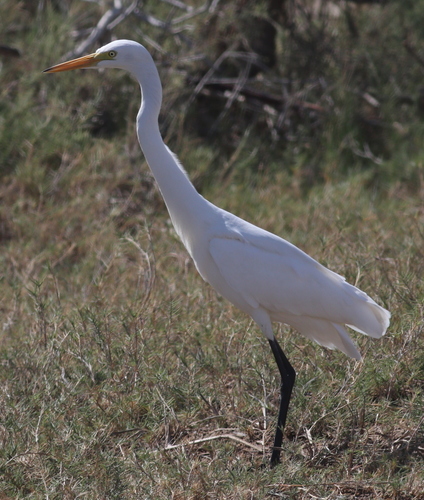

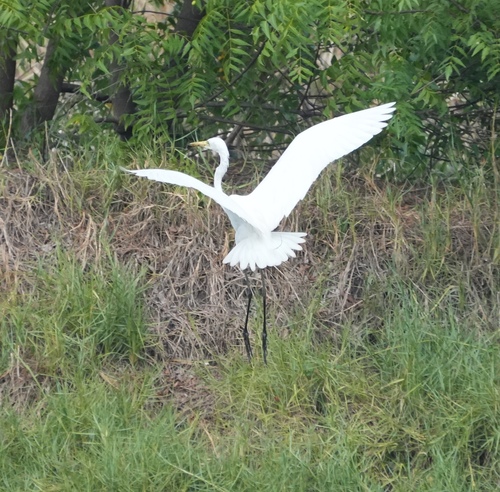

What the Medium Egret sounds like

ID tip
The medium egret, as its scientific name implies, is intermediate in size between the great egret and smaller white egrets like the little egret and cattle egret, though nearer to little than great. It is about 56–72 cm (22–28 in) long with a 105–115 cm (41–45 in) wingspan and weighs c. 400 g (14 oz), with all-white plumage, generally dark legs and a thickish yellow bill. Breeding birds may have a reddish or black bill, greenish yellow gape skin, loose filamentous plumes on their breast and back, and dull yellow or pink on their upper legs (regional variations). The sexes are similar.
Text from Wikipedia, licensed CC BY-SA 4.0.
When to see the Medium Egret
One bar for each month. Filled bars are the 10 months with records; pale bars are months with none. The wide bar is January, the month with the most records.
Where to see the Medium Egret
The map shades 44 countries with regular records, and 14 more in a lighter tone where the bird turns up only as a stray. Everything unshaded has no records. Countries are listed below the map.
Recorded as a rare visitor in United States, Seychelles, Uganda, Mozambique, Mongolia, Tanzania, ZZ, Egypt, Ghana, North Korea, Madagascar, Maldives, Senegal, Togo.
About the Medium Egret
The medium egret, median egret, smaller egret or intermediate egret, is a medium-sized heron. Some taxonomists put the species in the genus Egretta or Mesophoyx. It is a resident breeder in southern and eastern Asia.
Text adapted from Wikipedia, licensed CC BY-SA 4.0.
Easily confused with
 Yellow-billed EgretArdea brachyrhynchaThe yellow-billed egret has a length of 61 to 69 cm (24 to 27 in) and is white, resembling the great egret (A. alba) but differs in having a smaller bill and a gape which does not extend beyond the eye.
Plumed EgretArdea plumiferaThe plumed egret is a medium-sized heron, 56 to 70 cm (22 to 28 in) in length with an all white plumage.
Yellow-billed EgretArdea brachyrhynchaThe yellow-billed egret has a length of 61 to 69 cm (24 to 27 in) and is white, resembling the great egret (A. alba) but differs in having a smaller bill and a gape which does not extend beyond the eye.
Plumed EgretArdea plumiferaThe plumed egret is a medium-sized heron, 56 to 70 cm (22 to 28 in) in length with an all white plumage.
 Eastern Cattle EgretArdea coromandaThe cattle egret is a stocky heron with an 88–96 cm (35–38 in) wingspan; it is 46–56 cm (18–22 in) long and weighs 270–512 g (9.5–18.1 oz).
Learn the Medium Egret in the BeakBrain App
Photo and call practice. Coming soon to iPhone and Android.
Play today's Daily BirdEvery photo and recording on this page is credited to its author under the licence shown. Spotted a problem with this page, or have a better photo? Contribute.