Learn what every symbol on the card means.Full credits and sources at beakbrain.com/symbols
 WetlandPlatform nestLarge · 459 g




ID tip
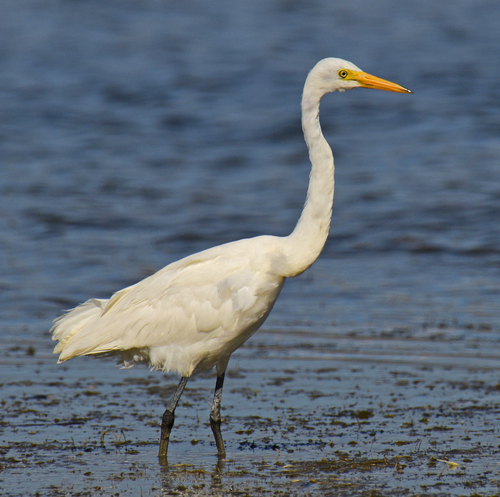
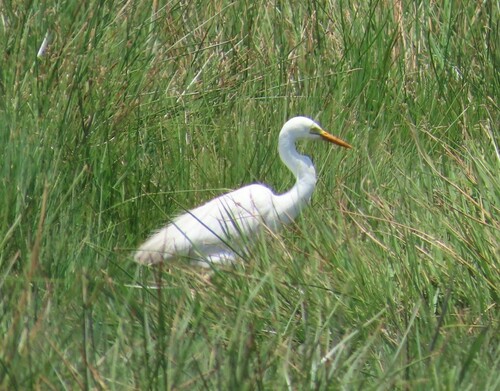
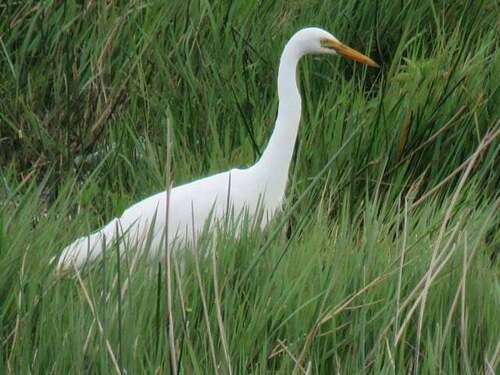
The yellow-billed egret has a length of 61 to 69 cm (24 to 27 in) and is white, resembling the great egret (A. alba) but differs in having a smaller bill and a gape which does not extend beyond the eye. In breeding plumage the yellow-billed egret grows long plumes on its back and breast and the normally yellow bill becomes orange red. The bill may have a black tip outside the breeding season. The lower legs and toes are dusky while the tibia is paler, becoming pinkish red for a short period during courtship before changing to yellow for the rest of the breeding season.
Text from Wikipedia, licensed CC BY-SA 4.0.
When to see the Yellow-billed Egret
One bar for each month, and every month is filled: this bird is recorded here in all twelve. The wide bar is November, the month with the most records.
Where to see the Yellow-billed Egret
The map shades 44 countries with regular records, and 6 more in a lighter tone where the bird turns up only as a stray. Everything unshaded has no records. Countries are listed below the map.
Recorded as a rare visitor in Spain, Italy, Lesotho, São Tomé & Príncipe, Portugal, Yemen.
About the Yellow-billed Egret
The yellow-billed egret is a species of heron, a medium sized heron. This species is found in Sub-Saharan Africa. Until 2023 the yellow-billed egret was regarded as a subspecies of the intermediate egret of Asia, as was the plumed egret of Australia and Oceania.
Text adapted from Wikipedia, licensed CC BY-SA 4.0.
Easily confused with
 Medium EgretArdea intermediaThe medium egret, as its scientific name implies, is intermediate in size between the great egret and smaller white egrets like the little egret and cattle egret, though nearer to little than great.
 Plumed EgretArdea plumiferaThe plumed egret is a medium-sized heron, 56 to 70 cm (22 to 28 in) in length with an all white plumage.
 Eastern Cattle EgretArdea coromandaThe cattle egret is a stocky heron with an 88–96 cm (35–38 in) wingspan; it is 46–56 cm (18–22 in) long and weighs 270–512 g (9.5–18.1 oz).
Learn the Yellow-billed Egret in the BeakBrain App
Photo and call practice. Coming soon to iPhone and Android.
Play today's Daily BirdEvery photo and recording on this page is credited to its author under the licence shown. Spotted a problem with this page, or have a better photo? Contribute.