Learn what every symbol on the card means.Full credits and sources at beakbrain.com/symbols
 ForestLarge · 1.5 kg


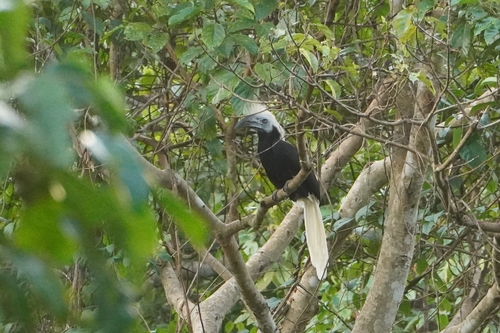
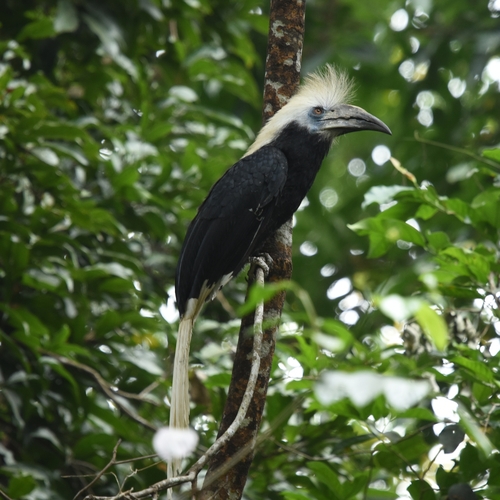
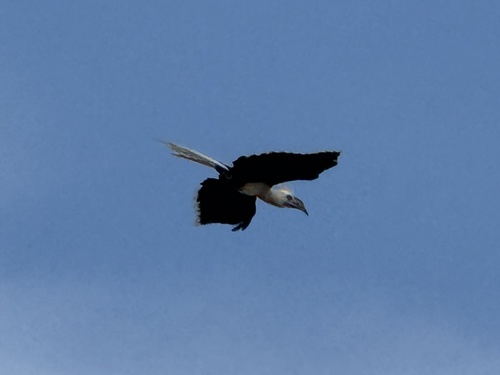
ID tip
Berenicornis comatus is a large hornbill, reaching a length of 83–102 cm (33–40 in) and a weight of 1.3–1.5 kg (2.9–3.3 lb). Females are smaller than males. The plumage is black and white. The head, neck, breast and tail are white, while the remaining plumage is black. It has white crown feathers erected in a crest (hence the common name). Between the eye and the bill and on the throat there is bare dark blue skin. The bill is mainly black, with a yellowish base. Like most hornbills, it has a blackish casque on the top of its bill. The female has a black neck and underparts.
Text from Wikipedia, licensed CC BY-SA 4.0.
When to see the White-crowned Hornbill
One bar for each month, and every month is filled: this bird is recorded here in all twelve. The wide bar is April, the month with the most records.
Where to see the White-crowned Hornbill
The map shades 5 countries with regular records, and 1 more in a lighter tone where the bird turns up only as a stray. Everything unshaded has no records. Countries are listed below the map.
Recorded as a rare visitor in Myanmar (Burma).
About the White-crowned Hornbill
The white-crowned hornbill, also known as the long-crested hornbill or white-crested hornbill, is a species of hornbill.
Text adapted from Wikipedia, licensed CC BY-SA 4.0.
Easily confused with
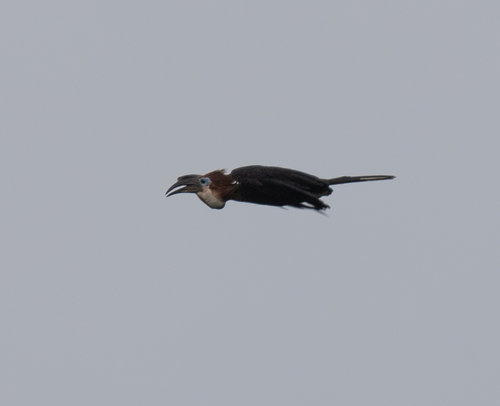 Black-casqued HornbillCeratogymna atrataThe black-casqued hornbill is a large, mostly black bird with bare-skinned blue wattles and skin around their eyes.
 Eastern Yellow-billed HornbillTockus flavirostrisThe Eastern yellow-billed hornbill, also known as the northern yellow-billed hornbill, is a species of hornbill in the family Bucerotidae.
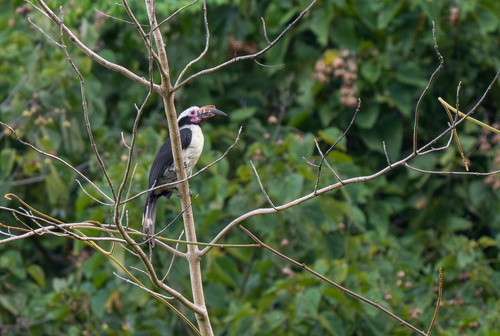 Luzon HornbillPenelopides manillaeEBird describes it as "A fairly large bird of lowland and foothill forest on Luzon and neighboring islands.
Learn the White-crowned Hornbill in the BeakBrain App
Photo and call practice. Coming soon to iPhone and Android.
Play today's Daily BirdEvery photo and recording on this page is credited to its author under the licence shown. Spotted a problem with this page, or have a better photo? Contribute.