Learn what every symbol on the card means.Full credits and sources at beakbrain.com/symbols
 ForestCavity nestLarge · 461 g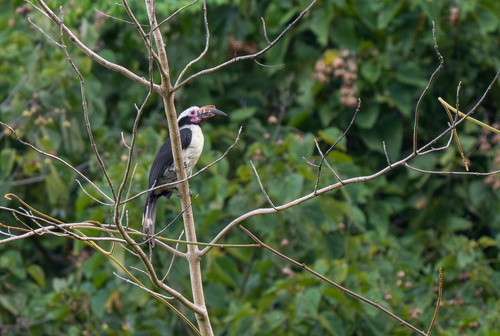
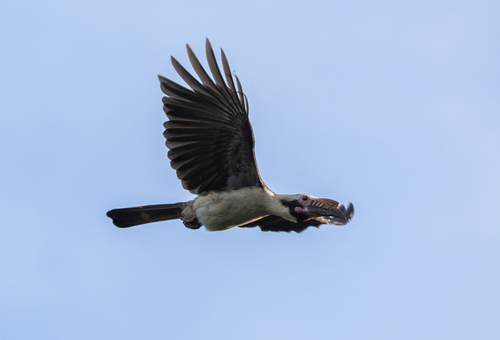
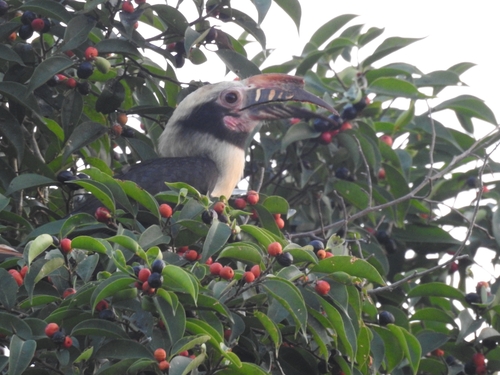
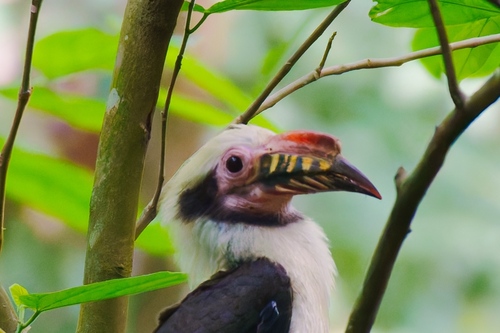
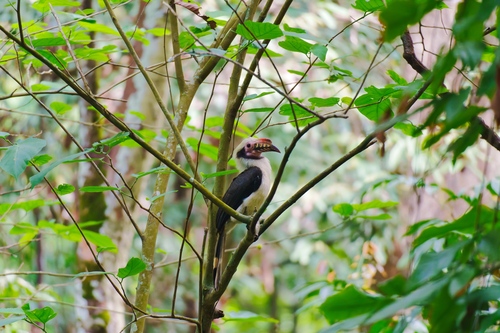


ID tip
EBird describes it as "A fairly large bird of lowland and foothill forest on Luzon and neighboring islands. Small for a hornbill. Bill fairly short with black bands. Has black wings and rump, a black tail with a pale band, and bare skin with a blue tinge around the eye and chin. Male has pale underparts and head with a black cheek, while female is entirely black. The only other hornbill in range is Rufous Hornbill, but Luzon lacks the red bill. Voice is a sharp, medium-pitched nasal honk, reminiscent of a squeaky toy."
Text from Wikipedia, licensed CC BY-SA 4.0.
When to see the Luzon Hornbill
One bar for each month. Filled bars are the 11 months with records; pale bars are months with none. The wide bar is March, the month with the most records.
Where to see the Luzon Hornbill
The map shades 1 country with regular records. Everything unshaded has no records. Countries are listed below the map.
About the Luzon Hornbill
The Luzon hornbill, sometimes called Luzon tarictic hornbill, is a species of hornbill in the family Bucerotidae. It is endemic to forests on Luzon and nearby islands in the northern Philippines. All five Philippine tarictics were once considered a single species. It is declining due to habitat destruction, hunting and the illegal wildlife trade.
Text adapted from Wikipedia, licensed CC BY-SA 4.0.
Easily confused with
 Mindanao HornbillPenelopides affinisThe Mindanao hornbill, also known as the Mindanao tarictic hornbill, is a medium-small species of hornbill found in the canopy of rainforests on Mindanao, Dinagat, Siargao and Basilan in the southern Philippines.
 Samar HornbillPenelopides samarensisThe Samar hornbill is a species of hornbill in the family Bucerotidae.
 Visayan HornbillPenelopides paniniThe adults show sexual dimorphism.
Learn the Luzon Hornbill in the BeakBrain App
Photo and call practice. Coming soon to iPhone and Android.
Play today's Daily BirdEvery photo and recording on this page is credited to its author under the licence shown. Spotted a problem with this page, or have a better photo? Contribute.