Learn what every symbol on the card means.Full credits and sources at beakbrain.com/symbols
 ForestCavity nestLarge · 1.2 kg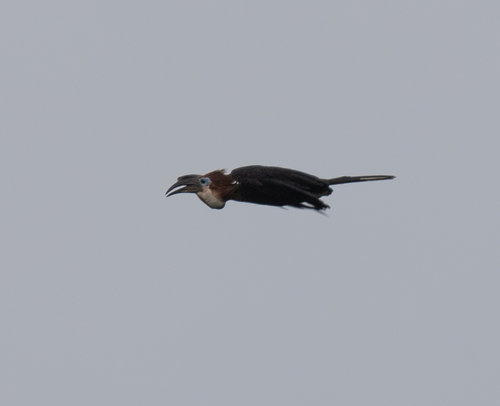


ID tip
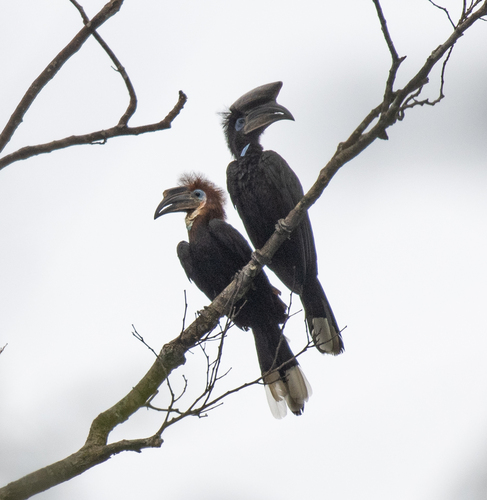
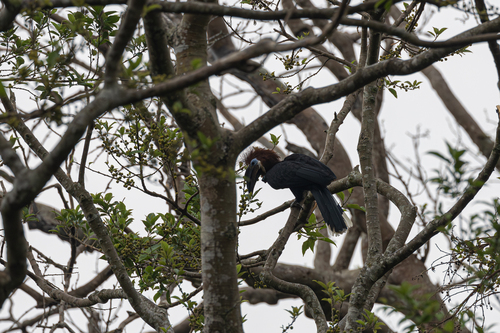
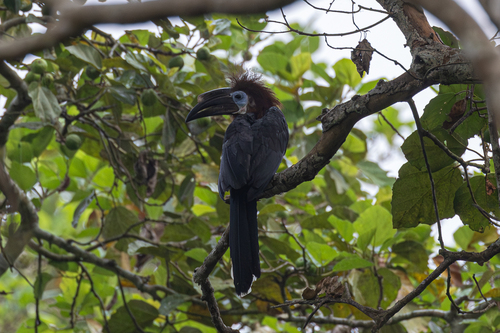
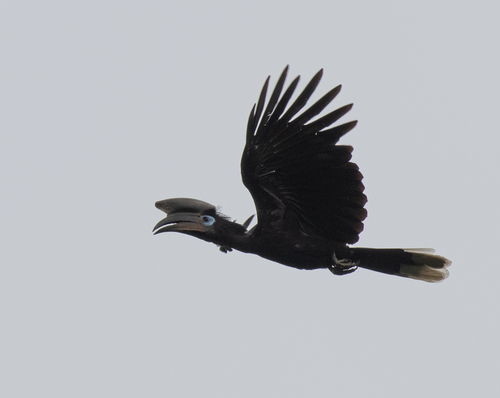
The black-casqued hornbill is a large, mostly black bird with bare-skinned blue wattles and skin around their eyes. Adult birds are typically between 60 and 70 cm (24 and 28 in) long, and can be distinguished from the similar yellow-casqued hornbill by the white scales found in their plumage. They are readily identifiable as a member of the hornbill family by the eponymous casque structure that the birds develop on their beaks as they mature. Like many bird species, black-casqued hornbills exhibit sexual dimorphism. The males are larger, with black heads, and a larger casque.
Text from Wikipedia, licensed CC BY-SA 4.0.
When to see the Black-casqued Hornbill
One bar for each month. Filled bars are the 11 months with records; pale bars are months with none. The wide bar is January, the month with the most records.
Where to see the Black-casqued Hornbill
The map shades 13 countries with regular records, and 1 more in a lighter tone where the bird turns up only as a stray. Everything unshaded has no records. Countries are listed below the map.
Recorded as a rare visitor in United States.
About the Black-casqued Hornbill
The black-casqued hornbill, or black-casqued wattled hornbill, is a species of hornbill in the family Bucerotidae. It is found fairly commonly across sub-Saharan Africa, being known from Sierra Leone and Liberia in Western Africa, south to Angola and east to the Democratic Republic of the Congo and western Uganda. They are currently considered of near threatened, and their population is declining.
Text adapted from Wikipedia, licensed CC BY-SA 4.0.
Easily confused with

Learn the Black-casqued Hornbill in the BeakBrain App
Photo and call practice. Coming soon to iPhone and Android.
Play today's Daily BirdEvery photo and recording on this page is credited to its author under the licence shown. Spotted a problem with this page, or have a better photo? Contribute.