Learn what every symbol on the card means.Full credits and sources at beakbrain.com/symbols
 WetlandPlatform nestHuge · 1.6 kg




ID tip
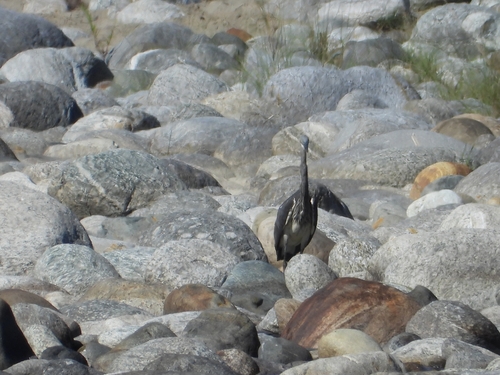
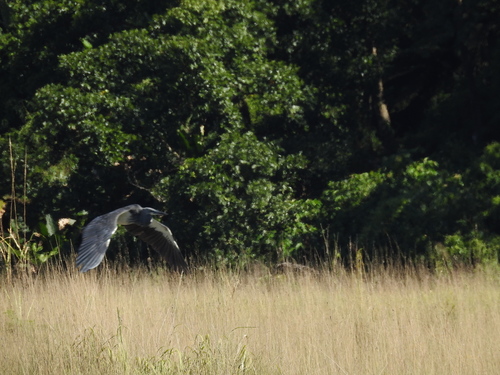
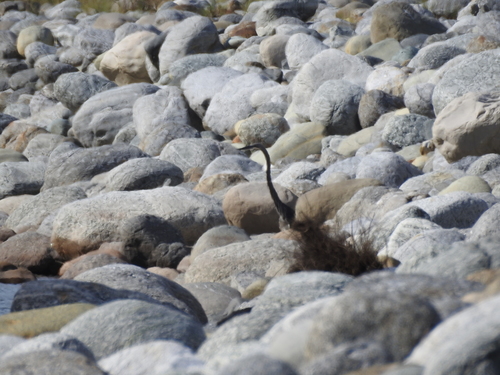
The white-bellied heron has a uniform dark grey plumage, a whitish belly, and long silvery or whitish plumes on the rear crown and lower foreneck. In breeding plumage, it has a greyish-white nape plume and elongated grey breast feathers with white centers. The face is greenish grey and the 15.2–17.6 cm (6.0–6.9 in) long bill black, but greenish near the base and tip; the iris is yellow to ochre, and the legs and feet are dull grey. Juveniles are browner above and have a paler bill and paler legs.
Text from Wikipedia, licensed CC BY-SA 4.0.
When to see the White-bellied Heron
One bar for each month. Filled bars are the 8 months with records; pale bars are months with none. The wide bar is April, the month with the most records.
Where to see the White-bellied Heron
The map shades 3 countries with regular records. Everything unshaded has no records. Countries are listed below the map.
About the White-bellied Heron
The white-bellied heron also known as the imperial heron or great white-bellied heron, is a large heron species living in the foothills of the eastern Himalayas in northeast India and Bhutan to northern Myanmar. It inhabits undisturbed rivers and wetlands. It has been listed as Critically Endangered on the IUCN Red List since 2007, because the global population is estimated at fewer than 250 mature individuals and threatened by habitat loss and human disturbance. It is mostly dark grey with a white throat and underparts.
Text adapted from Wikipedia, licensed CC BY-SA 4.0.
Easily confused with
 Humblot's HeronArdea humblotiHumblot's heron has a uniform dark gray plumage on its body and darker feathers on its forehead and chin.
 Yellow-billed EgretArdea brachyrhynchaThe yellow-billed egret has a length of 61 to 69 cm (24 to 27 in) and is white, resembling the great egret (A. alba) but differs in having a smaller bill and a gape which does not extend beyond the eye.
 Medium EgretArdea intermediaThe medium egret, as its scientific name implies, is intermediate in size between the great egret and smaller white egrets like the little egret and cattle egret, though nearer to little than great.
Learn the White-bellied Heron in the BeakBrain App
Photo and call practice. Coming soon to iPhone and Android.
Play today's Daily BirdEvery photo and recording on this page is credited to its author under the licence shown. Spotted a problem with this page, or have a better photo? Contribute.