Learn what every symbol on the card means.Full credits and sources at beakbrain.com/symbols
 ForestCavity nestLarge · 1.1 kg


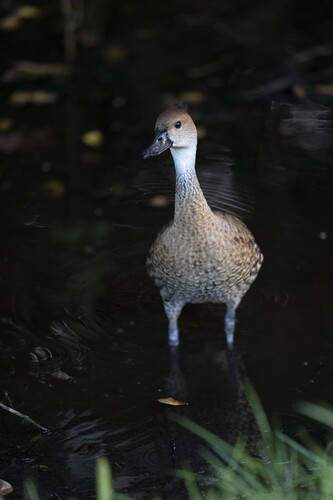
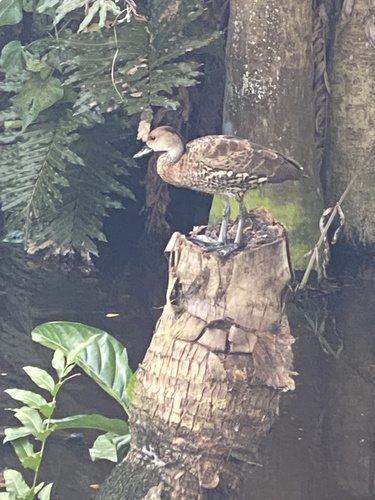
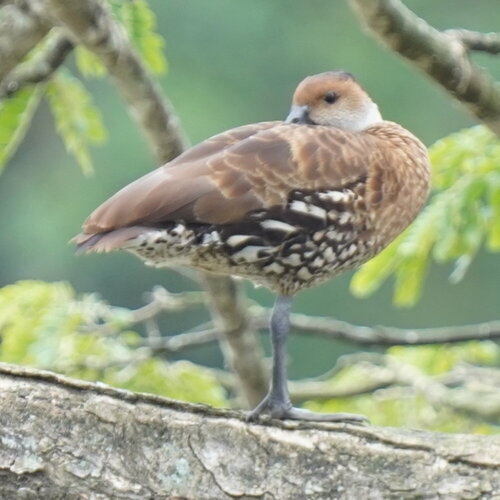
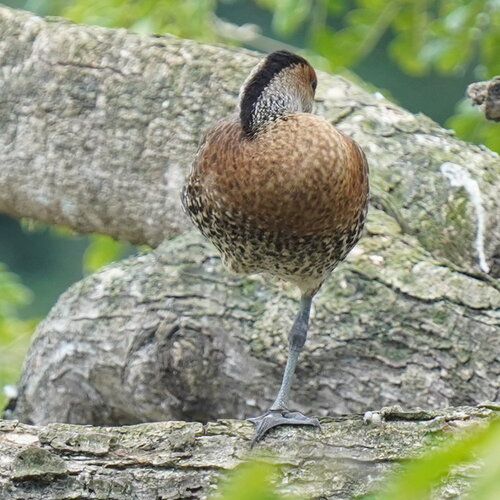
ID tip
The West Indian whistling duck is the largest and darkest of the whistling ducks with a length of 48 to 58 cm (19 to 23 in). The female weighs from 800 to 1,320 g (1.76 to 2.91 lb) and the male weighs from 760 to 1,240 g (1.68 to 2.73 lb); this species is about the size of a mallard. It has a long black bill, long head and longish legs. It has a pale foreneck and light brown face. The crown, back, breast and wings are dark brown to black, and the rest of the underparts are white with heavy black markings.
Text from Wikipedia, licensed CC BY-SA 4.0.
When to see the West Indian Whistling Duck
One bar for each month, and every month is filled: this bird is recorded here in all twelve. The wide bar is March, the month with the most records.
Where to see the West Indian Whistling Duck
The map shades 13 countries with regular records, and 3 more in a lighter tone where the bird turns up only as a stray. Everything unshaded has no records. Countries are listed below the map.
Recorded as a rare visitor in United States, Martinique, St. Barthélemy.
About the West Indian Whistling Duck
The West Indian whistling duck is a whistling duck that breeds in the Caribbean. Alternative names are black-billed whistling duck and Cuban whistling duck.
Text adapted from Wikipedia, licensed CC BY-SA 4.0.
Easily confused with
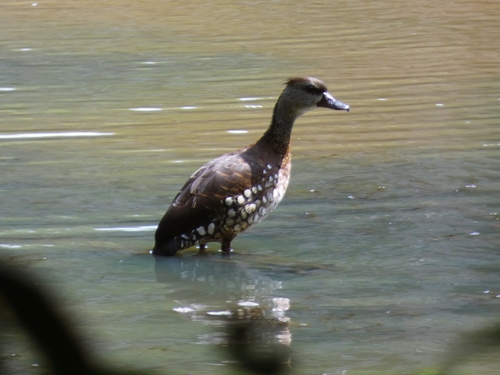 Spotted Whistling DuckDendrocygna guttataThe Spotted whistling duck is one of the smaller species in the genus Dendrocygna.
 Wandering Whistling DuckDendrocygna arcuataFormerly named tree ducks, the wandering whistling duck has its new name because of their loud whistling calls and the whistling noise their wings make during flight.
 Plumed Whistling DuckDendrocygna eytoniMeasuring 42–60 cm (16.5–23.5 in) and weighing around one kilogram (2.2 lb), it is a long-necked duck with brown upperparts, paler underparts and a white rump.
Side by side: Plumed Whistling Duck vs West Indian Whistling Duck · Wandering Whistling Duck vs West Indian Whistling Duck · Black-headed Duck vs West Indian Whistling Duck
Learn the West Indian Whistling Duck in the BeakBrain App
Photo and call practice. Coming soon to iPhone and Android.
Play today's Daily BirdEvery photo and recording on this page is credited to its author under the licence shown. Spotted a problem with this page, or have a better photo? Contribute.