Learn what every symbol on the card means.Full credits and sources at beakbrain.com/symbols
 WetlandCavity nestLarge · 800 g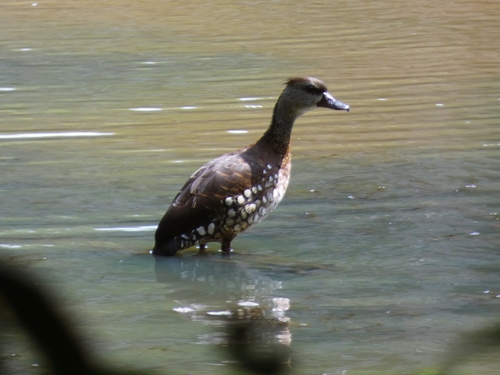


ID tip
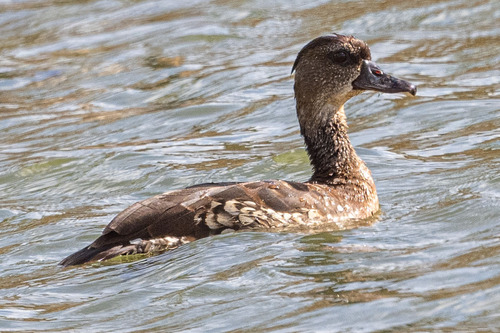
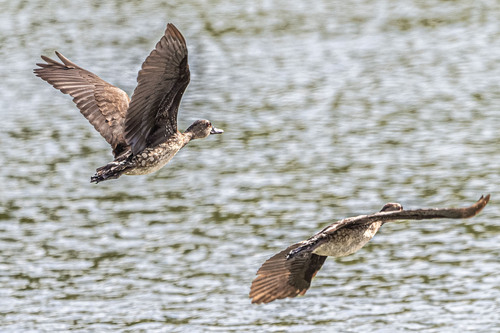
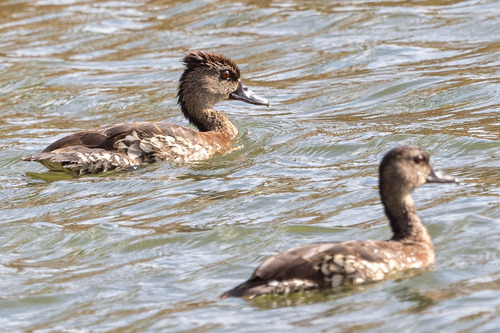
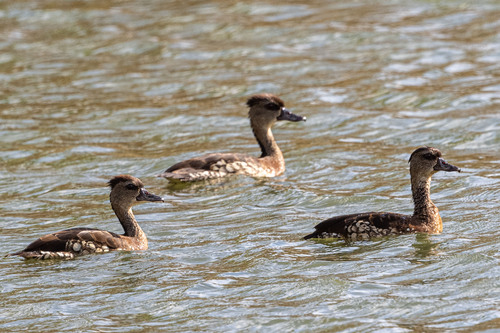
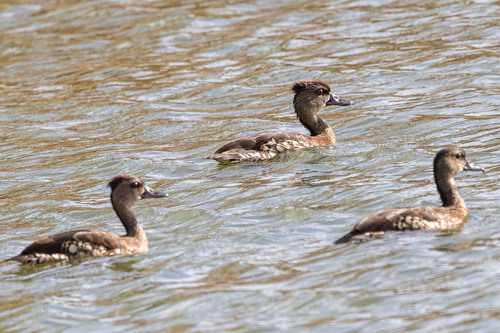
The Spotted whistling duck is one of the smaller species in the genus Dendrocygna. This duck grows to 43–50 cm tall. Males can weigh anywhere from 590g to 650g while females weigh 610g to 860g. White spots on their flanks and breasts gave these ducks the spotted name. The sides of the neck, faces, and eyebrows are all grey. Black or dark brown coloring stretches from the crown nape to the hindneck. This dark coloring is also found in the eyepatch. Their coloring resembles a cape with a thick collar. This cape starts as a light brown then fades into a darker brown closer to the tail.
Text from Wikipedia, licensed CC BY-SA 4.0.
When to see the Spotted Whistling Duck
One bar for each month. Filled bars are the 9 months with records; pale bars are months with none. The wide bar is January, the month with the most records.
Where to see the Spotted Whistling Duck
The map shades 3 countries with regular records. Everything unshaded has no records. Countries are listed below the map.
About the Spotted Whistling Duck
The spotted whistling duck is a member of the duck family Anatidae. It is also referred to as the "spotted tree duck". This duck can be found in Indonesia, New Guinea, Australia and the Philippines. Spotted ducks are also held in captive populations.
Text adapted from Wikipedia, licensed CC BY-SA 4.0.
Easily confused with
 West Indian Whistling DuckDendrocygna arboreaThe West Indian whistling duck is the largest and darkest of the whistling ducks with a length of 48 to 58 cm (19 to 23 in).
 Wandering Whistling DuckDendrocygna arcuataFormerly named tree ducks, the wandering whistling duck has its new name because of their loud whistling calls and the whistling noise their wings make during flight.
 Plumed Whistling DuckDendrocygna eytoniMeasuring 42–60 cm (16.5–23.5 in) and weighing around one kilogram (2.2 lb), it is a long-necked duck with brown upperparts, paler underparts and a white rump.
Learn the Spotted Whistling Duck in the BeakBrain App
Photo and call practice. Coming soon to iPhone and Android.
Play today's Daily BirdEvery photo and recording on this page is credited to its author under the licence shown. Spotted a problem with this page, or have a better photo? Contribute.