Learn what every symbol on the card means.Full credits and sources at beakbrain.com/symbols
 WetlandPlatform nestHuge · 6.4 kg


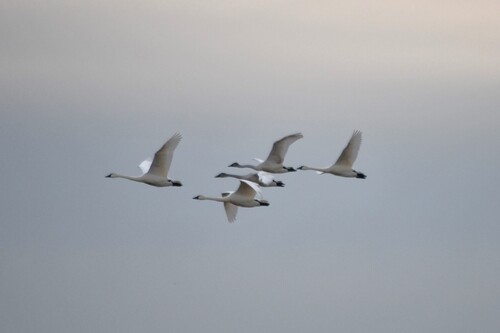
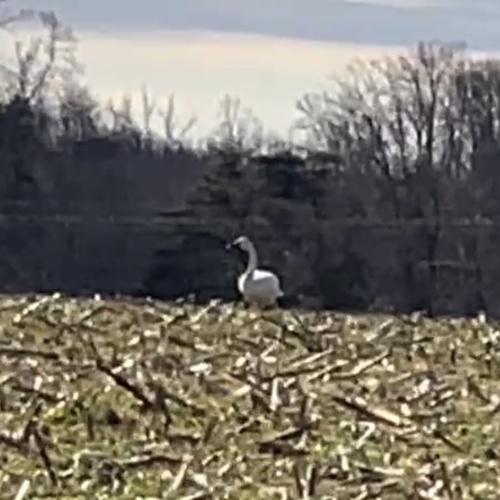
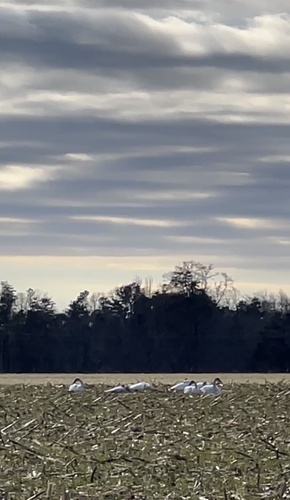
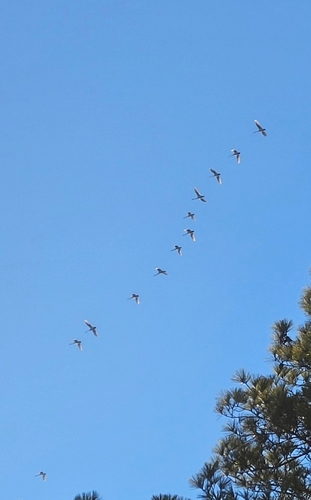
What the Tundra Swan sounds like

ID tip
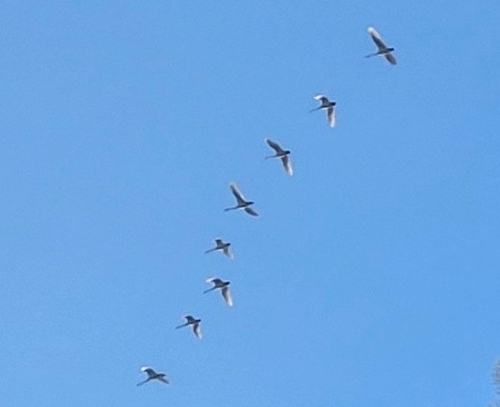
C. columbianus is the smallest of the Holarctic swans, at 115–150 cm (45–59 in) in length, 168–211 cm (66–83 in) in wingspan and a weight range of 3.4–9.6 kg (7.5–21.2 lb). In adult birds, the plumage of both subspecies is entirely white, with black feet, and a bill that is mostly black, with a thin salmon-pink streak running along the mouthline and – depending on the subspecies – more or less yellow in the proximal part. The iris is dark brown. In birds living in waters that contains large amounts of iron ions (e.g. bog lakes), the head and neck plumage acquires a golden or rusty hue. Voice: Tundra swans have high-pitched honking calls and sound similar to a black goose (Branta). They are particularly vocal when foraging in flocks on their wintering grounds; any conspecific arriving or leaving will elicit a bout of loud excited calling from its fellows.
Text from Wikipedia, licensed CC BY-SA 4.0.
When to see the Tundra Swan
One bar for each month. Filled bars are the 7 months with records; pale bars are months with none. The wide bar is March, the month with the most records.
Where to see the Tundra Swan
The map shades 48 countries with regular records, and 10 more in a lighter tone where the bird turns up only as a stray. Everything unshaded has no records. Countries are listed below the map.
Recorded as a rare visitor in Spain, India, Israel, Mexico, Puerto Rico, Uzbekistan, Albania, Luxembourg, St. Pierre & Miquelon, Oman.
About the Tundra Swan
The tundra swan is a Holarctic species of swan and the smallest of the Holarctic swans. It comprises two subspecies, which are sometimes treated as separate species: Bewick's swan of the Palaearctic and the whistling swan of the Nearctic.
Text adapted from Wikipedia, licensed CC BY-SA 4.0.
Easily confused with
 Trumpeter SwanCygnus buccinatorThe trumpeter swan is the largest extant species of waterfowl, and both the heaviest and longest native bird of North America.
 Black SwanCygnus atratusBlack swans are black-feathered birds, with white flight feathers.
 Whooper SwanCygnus cygnusThe whooper swan is similar in appearance to Bewick's swan.
Side by side: Mute Swan vs Tundra Swan · Tundra Swan vs Whooper Swan · Trumpeter Swan vs Tundra Swan · Black Swan vs Tundra Swan · Black-necked Swan vs Tundra Swan
Watch the Tundra Swan on live cams
 LIVE
LIVEBrowse all 118 bird cams worldwide, live and seasonal, by region and species.
Learn the Tundra Swan in the BeakBrain App
Photo and call practice. Coming soon to iPhone and Android.
Play today's Daily BirdEvery photo and recording on this page is credited to its author under the licence shown. Spotted a problem with this page, or have a better photo? Contribute.