Learn what every symbol on the card means.Full credits and sources at beakbrain.com/symbols
 WoodlandDomed nestTiny · 11 g


ID tip
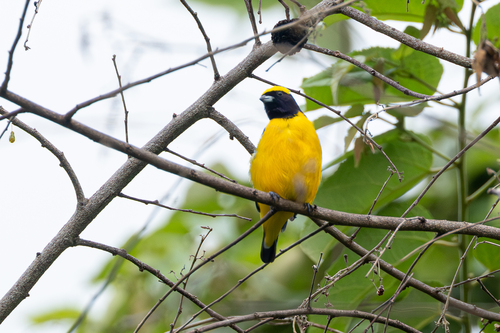
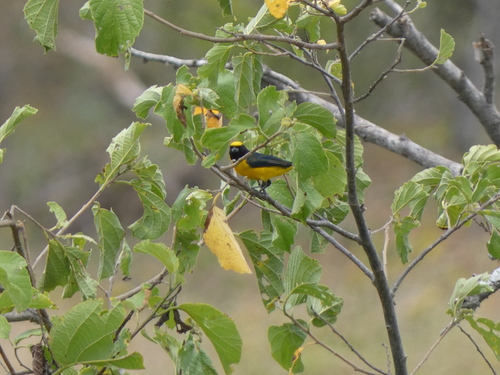
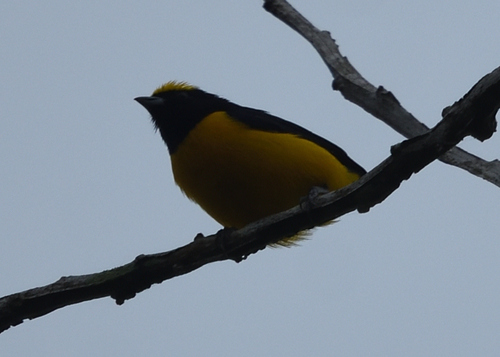
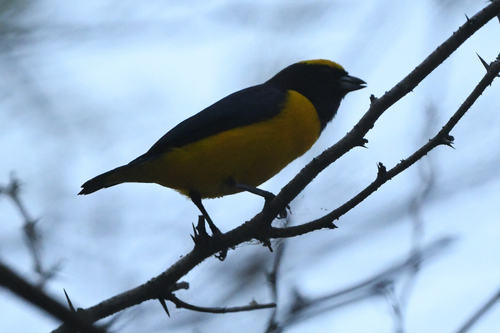
The Trinidad euphonia is a small, stout, short-tailed passerine, measuring 9.7–11 cm (3.8–4.3 in) in length and weighing 8.8–14 g (0.31–0.49 oz). It is sexually dimorphic in plumage. The male is glossy blue-black on the head, back, chin, and throat, with a bright yellow forehead and crown, and bright yellow underparts. The basal half of his rectrices are white, as are his underwing coverts; the latter results in a white stripe on his underwing when he flies. He also has white on the inner webs of the outer two to three tail feathers; this appears as two large white ovals on the undertail. Voice: A "notably vocal" species, the Trinidad euphonia has whistled calls that are high-pitched, plaintive, and hard to locate. The male typically sits at or near the top of a tree to call, often sitting on a semi-exposed or bare branch. One regular call, variously transcribed as "pee", "tee", or "dee", is typically doubled, though sometimes it is repeated 3–5 times, and exceptionally up to 20.
Text from Wikipedia, licensed CC BY-SA 4.0.
When to see the Trinidad Euphonia
One bar for each month, and every month is filled: this bird is recorded here in all twelve. The wide bar is October, the month with the most records.
Where to see the Trinidad Euphonia
The map shades 3 countries with regular records. Everything unshaded has no records. Countries are listed below the map.
About the Trinidad Euphonia
The Trinidad euphonia is a species of bird in the family Fringillidae. It is common in northern Colombia and northern Venezuela and uncommon to rare on the Caribbean island of Trinidad. Like all euphonias, it is small, stocky, and short-tailed; unlike some, it is sexually dimorphic. The male is glossy blue-black on the head, back, throat, and upper breast, with a bright yellow forehead and crown, and bright yellow underparts. The female is olive-green above and yellow-olive below, with a grayer patch running down the center of her breast and abdomen, and bright yellow undertail coverts.
Text adapted from Wikipedia, licensed CC BY-SA 4.0.
Easily confused with
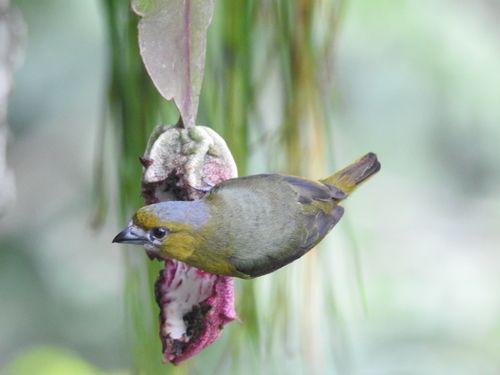 White-lored EuphoniaEuphonia chrysopastaThe white-lored euphonia is 9 to 10 cm (3.5 to 3.9 in) long and weighs about 11 to 16 g (0.39 to 0.56 oz).
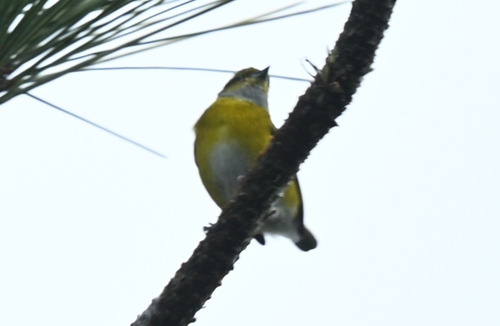 White-vented EuphoniaEuphonia minutaThe white-vented euphonia is about 9 cm (3.5 in) long and weighs about 8 to 11.5 g (0.28 to 0.41 oz).
 Spot-crowned EuphoniaEuphonia imitansThe spot-crowned euphonia is about 10 cm (3.9 in) long and weighs about 14 g (0.49 oz).
Side by side: Chestnut-bellied Euphonia vs Trinidad Euphonia · Tawny-capped Euphonia vs Trinidad Euphonia · Trinidad Euphonia vs White-vented Euphonia · Spot-crowned Euphonia vs Trinidad Euphonia
Learn the Trinidad Euphonia in the BeakBrain App
Photo and call practice. Coming soon to iPhone and Android.
Play today's Daily BirdEvery photo and recording on this page is credited to its author under the licence shown. Spotted a problem with this page, or have a better photo? Contribute.