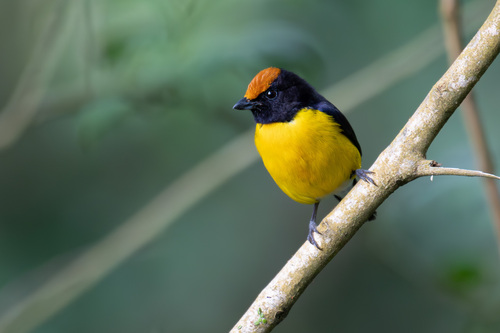
Tawny-capped Euphonia
Euphonia anneae
The tawny-cappeded euphonia is 10 to 11 cm (3.9 to 4.3 in) long and weighs about 15 g (0.53 oz). It is a small euphonia with a thick bill. The species is sexually dimorphic. Adult males of the nominate subspecies have a rich rufous-chestnut crown. The rest of their head and their nape, throat, upperwing coverts, and upperparts are glossy blue-black. Their flight feathers are dusky with dark blue edges and white inner webs at the base of most of them. Voice: The tawny-capped euphonia's "nmusical utterances are harsh and nasal". In more detail, its song is "a note or phrase repeated 2–4 times before changing, e.g. whee whee whee, wheer wheer, nah-a-a-ak, nah-a-a-ak, eeeenk eeenk eeenk, seeet seeet... and so on".
ID text from Wikipedia, CC BY-SA 4.0

Trinidad Euphonia
Euphonia trinitatis
The Trinidad euphonia is a small, stout, short-tailed passerine, measuring 9.7–11 cm (3.8–4.3 in) in length and weighing 8.8–14 g (0.31–0.49 oz). It is sexually dimorphic in plumage. The male is glossy blue-black on the head, back, chin, and throat, with a bright yellow forehead and crown, and bright yellow underparts. The basal half of his rectrices are white, as are his underwing coverts; the latter results in a white stripe on his underwing when he flies. He also has white on the inner webs of the outer two to three tail feathers; this appears as two large white ovals on the undertail. Voice: A "notably vocal" species, the Trinidad euphonia has whistled calls that are high-pitched, plaintive, and hard to locate. The male typically sits at or near the top of a tree to call, often sitting on a semi-exposed or bare branch. One regular call, variously transcribed as "pee", "tee", or "dee", is typically doubled, though sometimes it is repeated 3–5 times, and exceptionally up to 20.
ID text from Wikipedia, CC BY-SA 4.0
Learn this pair in the BeakBrain App
Photo and call practice. Coming soon to iPhone and Android.
Play today's Daily BirdPhotos and recordings are credited to their authors under the licence shown. Full profiles: Tawny-capped Euphonia and Trinidad Euphonia.