Learn what every symbol on the card means.Full credits and sources at beakbrain.com/symbols
 ForestDomed nestTiny · 14 g
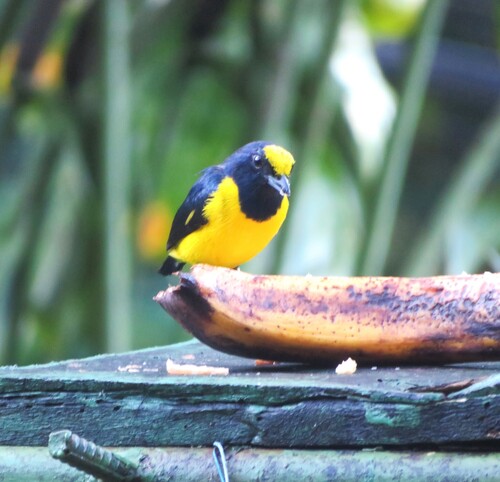
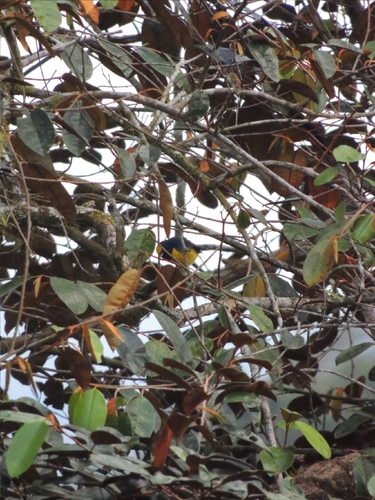
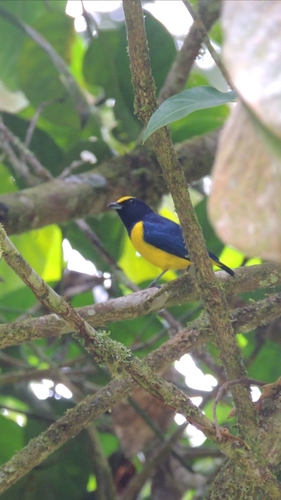


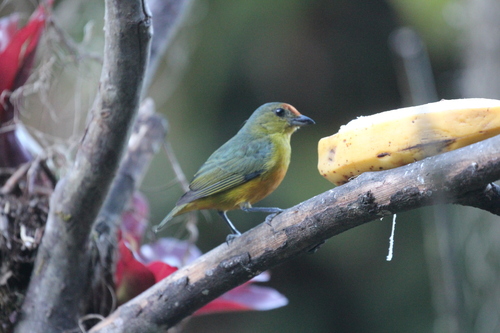


ID tip
The spot-crowned euphonia is about 10 cm (3.9 in) long and weighs about 14 g (0.49 oz). It is a small euphonia with a stubby bill. The species is sexually dimorphic. Adult males have a bright yellow forehead; the patch extends to the rear of the eye and is speckled with black. The rest of their crown and their face, nape, throat, chest, and upperparts are steely blue-black. Their upperwing coverts are a slightly glossy blue-black. Their flight feathers are dusky with a blue-black tinge and white bases on the inner webs of most feathers. Their tail is dusky with a blue-black tinge. Voice: The spot-crowned euphonia "produces rolling, buzzy utterances". Its song "typically consists of a note or phrase repeated 5–8 times, followed by abrupt shift to another series; some songs are clear sweet warbles, others chaffy or wheezy and dry, e.g. chip a cheer weet; chip tuck tuck; wee churee-cha..., and so on". A song bout may last up to 30 minutes.
Text from Wikipedia, licensed CC BY-SA 4.0.
When to see the Spot-crowned Euphonia
One bar for each month. Filled bars are the 11 months with records; pale bars are months with none. The wide bar is January, the month with the most records.
Where to see the Spot-crowned Euphonia
The map shades 2 countries with regular records. Everything unshaded has no records. Countries are listed below the map.
About the Spot-crowned Euphonia
The spot-crowned euphonia is a species of bird in the family Fringillidae, the finches and euphonias. It is found in Costa Rica and Panama.
Text adapted from Wikipedia, licensed CC BY-SA 4.0.
Easily confused with
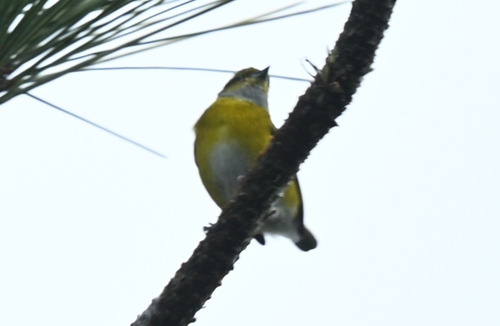 White-vented EuphoniaEuphonia minutaThe white-vented euphonia is about 9 cm (3.5 in) long and weighs about 8 to 11.5 g (0.28 to 0.41 oz).
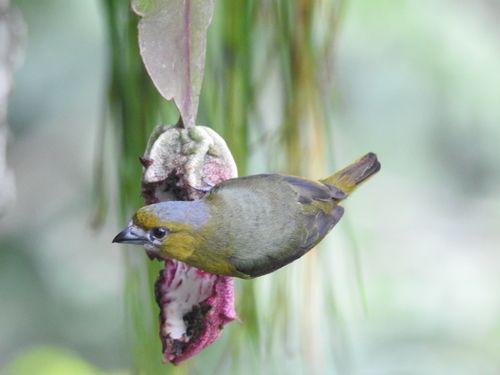 White-lored EuphoniaEuphonia chrysopastaThe white-lored euphonia is 9 to 10 cm (3.5 to 3.9 in) long and weighs about 11 to 16 g (0.39 to 0.56 oz).
 Trinidad EuphoniaEuphonia trinitatisThe Trinidad euphonia is a small, stout, short-tailed passerine, measuring 9.7–11 cm (3.8–4.3 in) in length and weighing 8.8–14 g (0.31–0.49 oz).
Side by side: Spot-crowned Euphonia vs Trinidad Euphonia · Iiwi vs Spot-crowned Euphonia · Spot-crowned Euphonia vs White-vented Euphonia
Learn the Spot-crowned Euphonia in the BeakBrain App
Photo and call practice. Coming soon to iPhone and Android.
Play today's Daily BirdEvery photo and recording on this page is credited to its author under the licence shown. Spotted a problem with this page, or have a better photo? Contribute.