Learn what every symbol on the card means.Full credits and sources at beakbrain.com/symbols
 WetlandCavity nestSmall · 21 g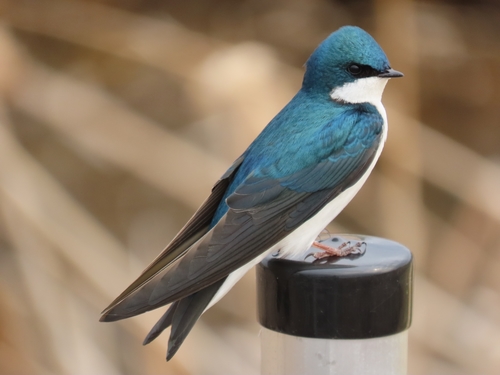
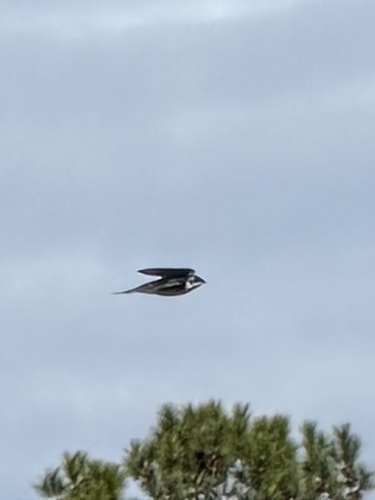
What the Tree Swallow sounds like


ID tip
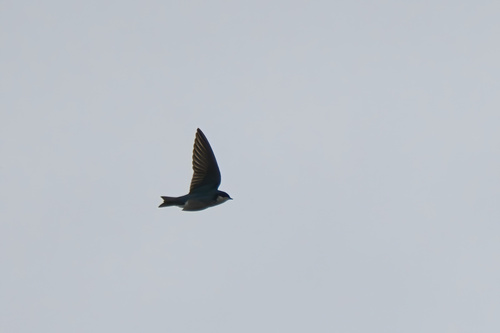
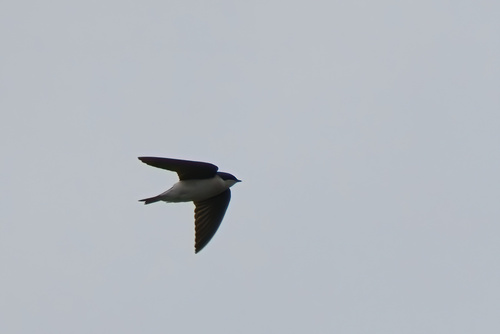
The tree swallow has a length between about 12 and 14 cm (4.7 and 5.5 in) and a weight of approximately 17 to 25.5 g (0.60 to 0.90 oz). Wingspan ranges from 30 to 35 cm (12 to 14 in). The male has mostly glossy blue-green upperparts, the wings and tail being blackish. The underparts and the cheek patch are white, although the underwing coverts are gray-brown. The bill is black, the eyes dark brown, and the legs and feet pale brown. The female is duller in color than the male, and sometimes has a brown forehead. Voice: The tree swallow's song consists of three parts: the chirp, the whine, and the gurgle. These sections may be repeated or omitted, and all can stand alone.
Text from Wikipedia, licensed CC BY-SA 4.0.
When to see the Tree Swallow
One bar for each month. Filled bars are the 6 months with records; pale bars are months with none. The wide bar is May, the month with the most records.
Where to see the Tree Swallow
The map shades 21 countries with regular records, and 7 more in a lighter tone where the bird turns up only as a stray. Everything unshaded has no records. Countries are listed below the map.
Recorded as a rare visitor in United Kingdom, Colombia, Portugal, Iceland, Russia, French Guiana, France.
About the Tree Swallow
The tree swallow is a migratory bird of the family Hirundinidae. Found in the Americas, the tree swallow was first described in 1807 by French ornithologist Louis Vieillot as Hirundo bicolor. It has since been moved to its current genus, Tachycineta, within which its phylogenetic placement is debated. The tree swallow has glossy blue-green upperparts, with the exception of the blackish wings and tail, and white underparts. The bill is black, the eyes dark brown, and the legs and feet pale brown. The female is generally duller than the male, and the first-year female has mostly brown upperparts, with some blue feathers. Juveniles have brown upperparts, and gray-brown-washed breasts.
Text adapted from Wikipedia, licensed CC BY-SA 4.0.
Easily confused with
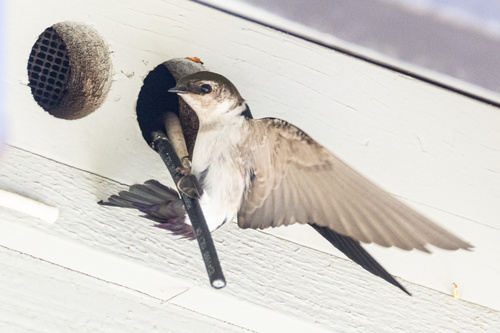 Violet-green SwallowTachycineta thalassinaThe distinct body form of swallows distinguishes them from other passerine birds.
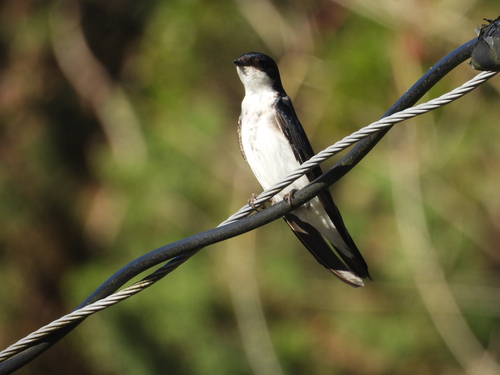 Chilean SwallowTachycineta leucopygaThe Chilean swallow is about 13 centimetres (5.1 in) in length and weighs 15–20 grams (0.53–0.71 oz).
 Mangrove SwallowTachycineta albilineaA relatively small swallow, the mangrove swallow is 11–12 centimetres (4.3–4.7 in) long and weighs about 14 grams (0.5 oz).
Side by side: Tree Swallow vs Violet-green Swallow · Chilean Swallow vs Tree Swallow · Mangrove Swallow vs Tree Swallow
Learn the Tree Swallow in the BeakBrain App
Photo and call practice. Coming soon to iPhone and Android.
Play today's Daily BirdEvery photo and recording on this page is credited to its author under the licence shown. Spotted a problem with this page, or have a better photo? Contribute.