Learn what every symbol on the card means.Full credits and sources at beakbrain.com/symbols
 WoodlandCavity nestSmall · 17 g


ID tip
A relatively small swallow, the mangrove swallow is 11–12 centimetres (4.3–4.7 in) long and weighs about 14 grams (0.5 oz). The adult has iridescent blue-green upperparts, white underparts, rump, and undertail- and wing-coverts, and blackish tail and flight feathers. The feathers are greener when fresh and bluer when worn. The white underparts sometimes have faint, dark shaft streaks. The bill is small and black, about 11 millimetres (0.43 in) long. The iris is a dark brown, and the tarsus and toes range in colour from black to fuscous-brown.
Text from Wikipedia, licensed CC BY-SA 4.0.
When to see the Mangrove Swallow
One bar for each month. Filled bars are the 11 months with records; pale bars are months with none. The wide bar is March, the month with the most records.
Where to see the Mangrove Swallow
The map shades 8 countries with regular records, and 2 more in a lighter tone where the bird turns up only as a stray. Everything unshaded has no records. Countries are listed below the map.
Recorded as a rare visitor in United States, Colombia.
About the Mangrove Swallow
The mangrove swallow is a passerine bird in the swallow family that breeds in coastal regions from Mexico through Central America to Panama. It has blue-green upperparts, blackish flight feathers, a white rump, a black tail, and white underparts. It can be identified by the supraloral white streak, the white line near its eye, which only occurs in two other species of Tachycineta: the violet-green swallow and the white-rumped swallow. The sexes, although similar in plumage, differ slightly in size. The juveniles have grey-brown upperparts and white-washed underparts. This swallow's song is generally described as a soft trilling, with a rolled jeerrt call, and a sharp alarm note.
Text adapted from Wikipedia, licensed CC BY-SA 4.0.
Easily confused with
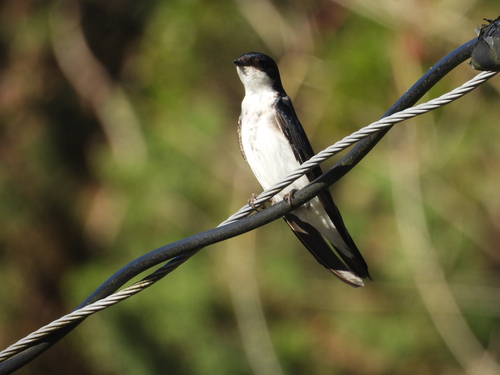 Chilean SwallowTachycineta leucopygaThe Chilean swallow is about 13 centimetres (5.1 in) in length and weighs 15–20 grams (0.53–0.71 oz).
 White-winged SwallowTachycineta albiventerThe adult white-winged swallow is 14 cm (5.5 in) long and weighs 14–17 g (0.49–0.60 oz).
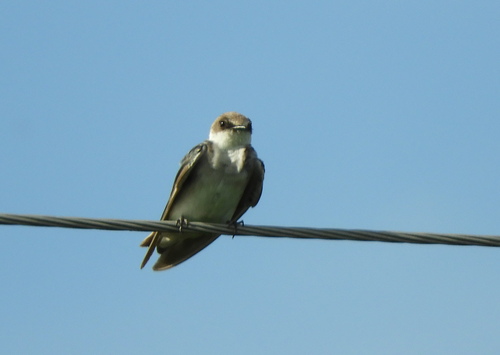 White-rumped SwallowTachycineta leucorrhoaThe white-rumped swallow measures 13 centimetres (5.1 in) in length and weighs 17–21 grams (0.60–0.74 oz).
Side by side: Mangrove Swallow vs Tree Swallow · Mangrove Swallow vs Violet-green Swallow · Chilean Swallow vs Mangrove Swallow · Mangrove Swallow vs White-winged Swallow · Mangrove Swallow vs White-rumped Swallow
Learn the Mangrove Swallow in the BeakBrain App
Photo and call practice. Coming soon to iPhone and Android.
Play today's Daily BirdEvery photo and recording on this page is credited to its author under the licence shown. Spotted a problem with this page, or have a better photo? Contribute.