Learn what every symbol on the card means.Full credits and sources at beakbrain.com/symbols
 GrasslandScrapeMedium · 79 g

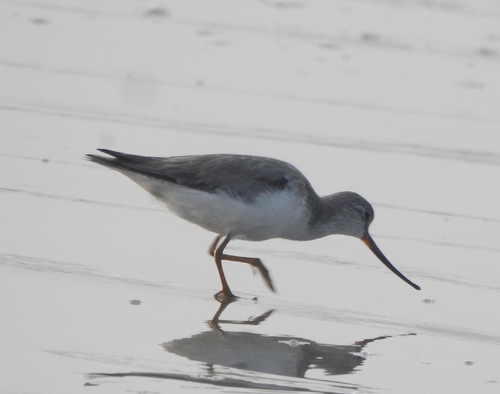
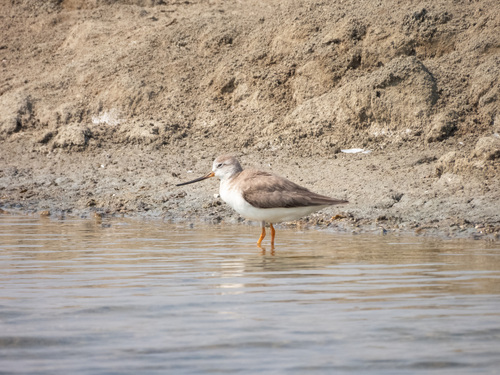
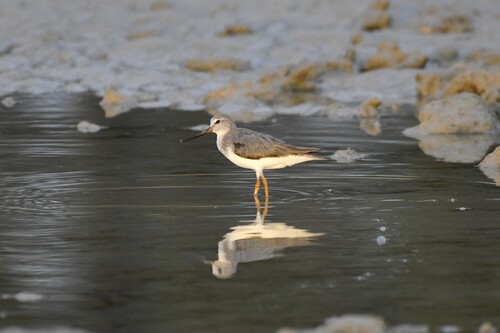
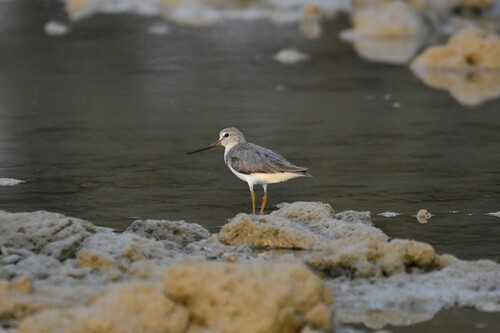
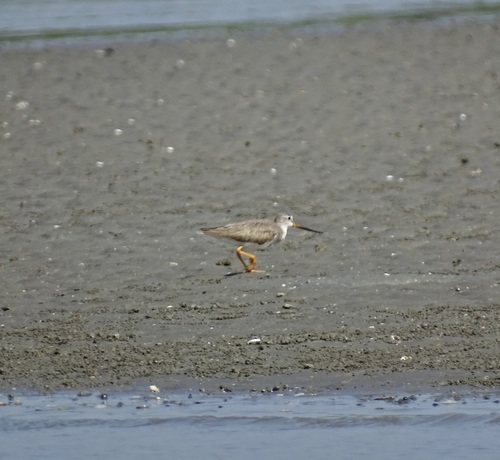
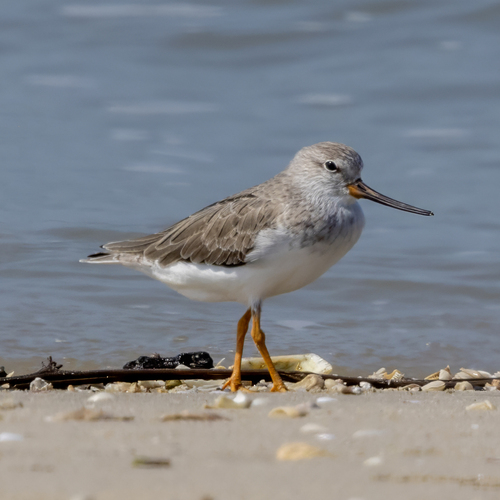
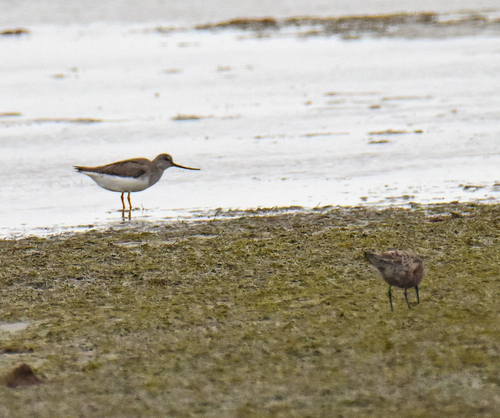
What the Terek Sandpiper sounds like

ID tip
Slightly larger than the common sandpiper at 22–25 cm (8.7–9.8 in) length, its long upcurved bill – somewhat reminiscent of an avocet's, but not as strongly curved – makes it very distinctive. As the scientific specific name implies, this wader has a grey back, face and breast in all plumages; a white supercilium may appear more or less distinct. The belly is whitish and the feet yellow; the bill has a yellowish base, with the rest being black. The call is a high whistle.
Text from Wikipedia, licensed CC BY-SA 4.0.
When to see the Terek Sandpiper
One bar for each month. Filled bars are the 11 months with records; pale bars are months with none. The wide bar is May, the month with the most records.
Where to see the Terek Sandpiper
The map shades 95 countries with regular records, and 9 more in a lighter tone where the bird turns up only as a stray. Everything unshaded has no records. Countries are listed below the map.
Recorded as a rare visitor in United States, Netherlands, Canada, Eswatini, French Guiana, Mexico, Botswana, Cameroon, Tajikistan.
About the Terek Sandpiper
The Terek sandpiper is a small migratory Palearctic wader species and is the only member of the genus Xenus. It is named after the Terek River which flows into the west of the Caspian Sea, as it was first observed around this area.
Text adapted from Wikipedia, licensed CC BY-SA 4.0.
Easily confused with
 Far Eastern CurlewNumenius madagascariensisThe Far Eastern curlew is a large wader most similar in appearance to the long-billed curlew, but slightly larger.
 Broad-billed SandpiperCalidris falcinellusBroad-billed sandpipers are small waders, 16–18 cm long, slightly smaller than the dunlin, but larger than the little stint; it has a longer, straighter bill with the tip distinctly kinked down, and shorter legs than dunlin.
 SurfbirdCalidris virgataThe surfbird is a large sandpiper, reminiscent of the turnstones or the great knot.
Side by side: Surfbird vs Terek Sandpiper · Broad-billed Sandpiper vs Terek Sandpiper
Learn the Terek Sandpiper in the BeakBrain App
Photo and call practice. Coming soon to iPhone and Android.
Play today's Daily BirdEvery photo and recording on this page is credited to its author under the licence shown. Spotted a problem with this page, or have a better photo? Contribute.