Learn what every symbol on the card means.Full credits and sources at beakbrain.com/symbols
 WetlandScrapeSmall · 37 g


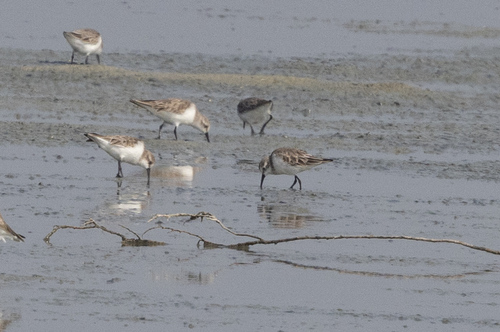
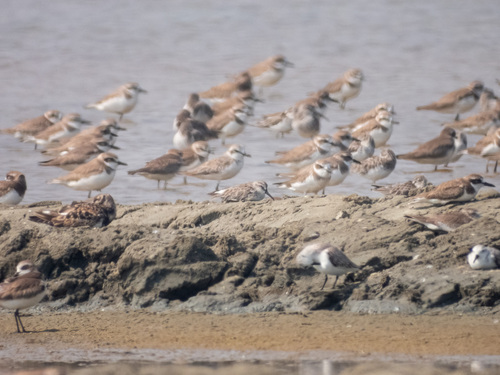
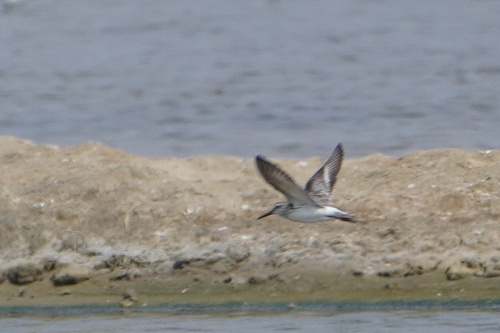
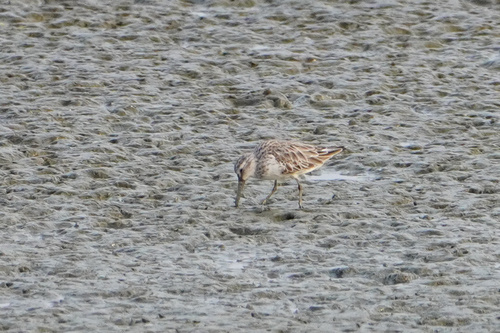
What the Broad-billed Sandpiper sounds like

ID tip
Broad-billed sandpipers are small waders, 16–18 cm long, slightly smaller than the dunlin, but larger than the little stint; it has a longer, straighter bill with the tip distinctly kinked down, and shorter legs than dunlin. The breeding adult has dark brown upperparts patterned with narrow, pale feather fringes, and white underparts with blackish markings on the breast. It has a pale crown stripe, and a distinctive double (split) supercilium.
Text from Wikipedia, licensed CC BY-SA 4.0.
When to see the Broad-billed Sandpiper
One bar for each month. Filled bars are the 6 months with records; pale bars are months with none. The wide bar is May, the month with the most records.
Where to see the Broad-billed Sandpiper
The map shades 77 countries with regular records, and 12 more in a lighter tone where the bird turns up only as a stray. Everything unshaded has no records. Countries are listed below the map.
Recorded as a rare visitor in United States, Netherlands, Portugal, Ireland, Djibouti, Morocco, Uganda, Zimbabwe, North Korea, Albania, Faroe Islands, Northern Mariana Islands.
About the Broad-billed Sandpiper
The broad-billed sandpiper is a small wading bird. The scientific specific name falcinellus is the diminutive from Latin falx, falcis, "a small sickle". It was formerly treated in its own monospecific genus Limicola, but this was found to be embedded within the wider genus Calidris, into which it was transferred in 2004.
Text adapted from Wikipedia, licensed CC BY-SA 4.0.
Easily confused with
 SurfbirdCalidris virgataThe surfbird is a large sandpiper, reminiscent of the turnstones or the great knot.
 Buff-breasted SandpiperCalidris subruficollisThis species is brown above and has a buff face and underparts in all plumages.
 Great KnotCalidris tenuirostrisThe great knot is a medium-sized wader.
Side by side: Broad-billed Sandpiper vs Sharp-tailed Sandpiper · Broad-billed Sandpiper vs Surfbird · Broad-billed Sandpiper vs Terek Sandpiper · Broad-billed Sandpiper vs Buff-breasted Sandpiper
Learn the Broad-billed Sandpiper in the BeakBrain App
Photo and call practice. Coming soon to iPhone and Android.
Play today's Daily BirdEvery photo and recording on this page is credited to its author under the licence shown. Spotted a problem with this page, or have a better photo? Contribute.