Learn what every symbol on the card means.Full credits and sources at beakbrain.com/symbols
 ForestCup nestSmall · 37 g


ID tip
Voice: The song of the St. Lucia orioles is a series, composed of two second long varied whistles played in a sequence. It is not known whether the species produces different series with unique variations of whistles or merely repeats the same sequence each time. The song is comparable to that of the Orchard Oriole, with one distinction being that it is weaker.
Text from Wikipedia, licensed CC BY-SA 4.0.
When to see the St. Lucia Oriole
One bar for each month. Filled bars are the 10 months with records; pale bars are months with none. The wide bar is March, the month with the most records.
Where to see the St. Lucia Oriole
The map shades 1 country with regular records. Everything unshaded has no records. Countries are listed below the map.
About the St. Lucia Oriole
The Saint Lucia oriole (Icterus laudablis) is a species of songbird endemic to Saint Lucia. Locally known as the Corouge, it is in the family Icteridae and the genus Icterus. Due to human development, this species of Oriole has seen significant population decline due to invasive species and habitat loss.
Text adapted from Wikipedia, licensed CC BY-SA 4.0.
Easily confused with
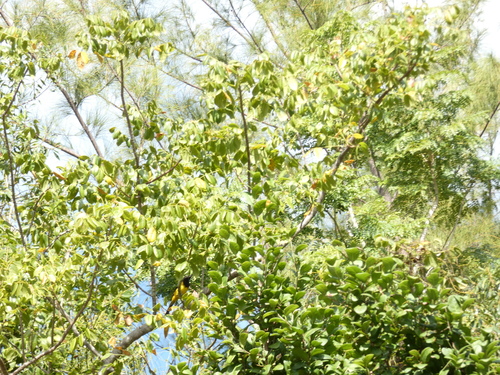 Bahama OrioleIcterus northropiThe Bahama oriole is a black and yellow oriole that has small white markings on the wings and tail.
 Montserrat OrioleIcterus oberiThe Montserrat oriole is 20 to 22 cm (7.9 to 8.7 in) long.
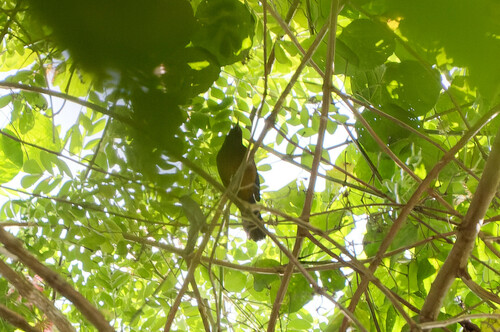 Martinique OrioleIcterus bonanaCompared to the other orioles of the Lesser Antilles, this oriole spots the most unusual plumage coloration.
Learn the St. Lucia Oriole in the BeakBrain App
Photo and call practice. Coming soon to iPhone and Android.
Play today's Daily BirdEvery photo and recording on this page is credited to its author under the licence shown. Spotted a problem with this page, or have a better photo? Contribute.