Learn what every symbol on the card means.Full credits and sources at beakbrain.com/symbols
 ForestDomed nestSmall · 40 g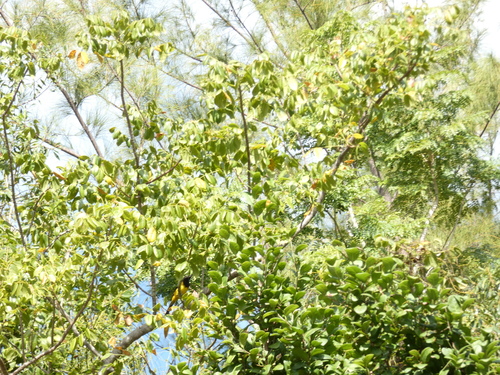
ID tip
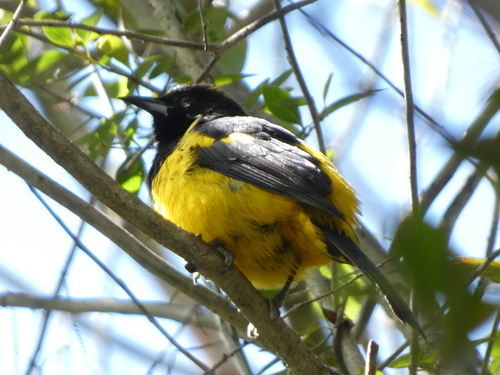
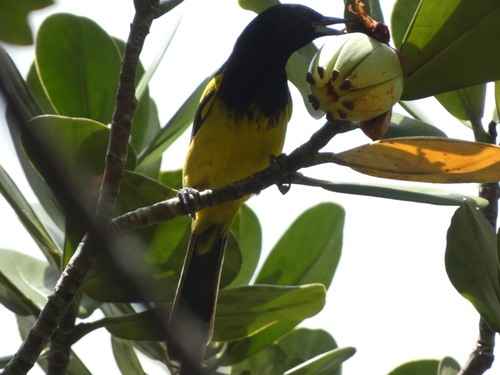
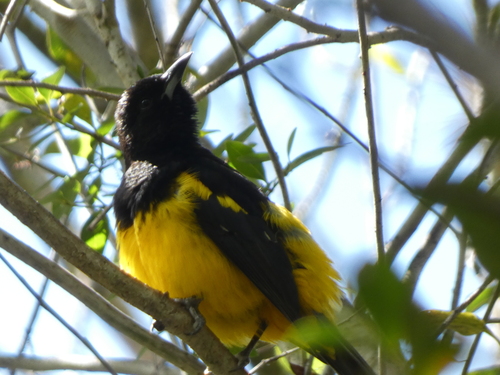
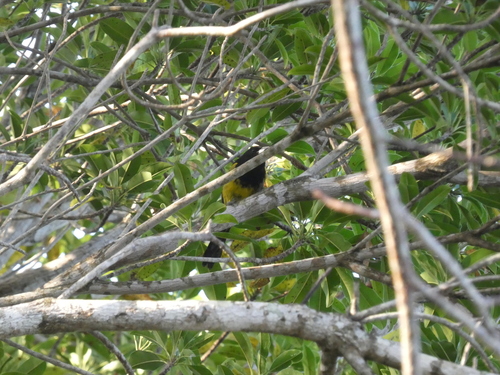
The Bahama oriole is a black and yellow oriole that has small white markings on the wings and tail. It shows the most yellow out of all the Caribbean orioles. The adult male and females are mostly black with yellow underparts, ranging from the mid-breast to the vent, thighs, rump, and lower back. The greater coverts and primaries are thinly fringed with white. The wing linings are yellow and the outer tail feathers have small white tips. The bill and eyes are dark black, and the legs are blue-grey.
Text from Wikipedia, licensed CC BY-SA 4.0.
When to see the Bahama Oriole
One bar for each month. Filled bars are the 9 months with records; pale bars are months with none. The wide bar is March, the month with the most records.
Where to see the Bahama Oriole
The map shades 1 country with regular records. Everything unshaded has no records. Countries are listed below the map.
About the Bahama Oriole
The Bahama oriole is a species of songbird in the New World blackbird family Icteridae. It is endemic to the Bahamas, and listed as endangered by the IUCN Red List.
Text adapted from Wikipedia, licensed CC BY-SA 4.0.
Easily confused with
 Montserrat OrioleIcterus oberiThe Montserrat oriole is 20 to 22 cm (7.9 to 8.7 in) long.
 Martinique OrioleIcterus bonanaCompared to the other orioles of the Lesser Antilles, this oriole spots the most unusual plumage coloration.
 St. Lucia OrioleIcterus laudabilisVoice: The song of the St. Lucia orioles is a series, composed of two second long varied whistles played in a sequence.
Learn the Bahama Oriole in the BeakBrain App
Photo and call practice. Coming soon to iPhone and Android.
Play today's Daily BirdEvery photo and recording on this page is credited to its author under the licence shown. Spotted a problem with this page, or have a better photo? Contribute.