Learn what every symbol on the card means.Full credits and sources at beakbrain.com/symbols
 ForestCup nestSmall · 29 g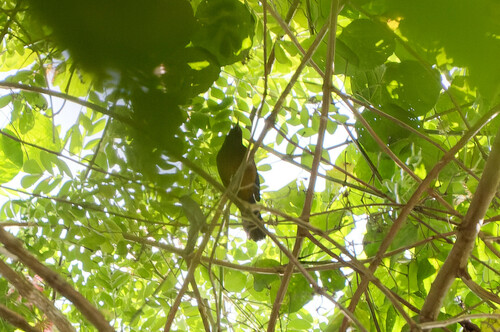
ID tip
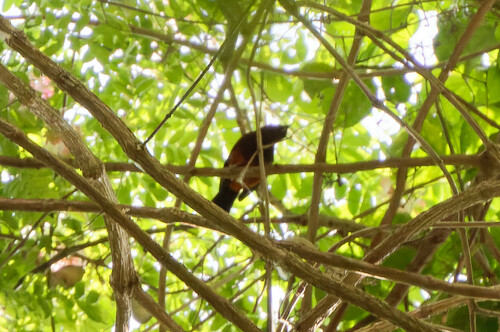
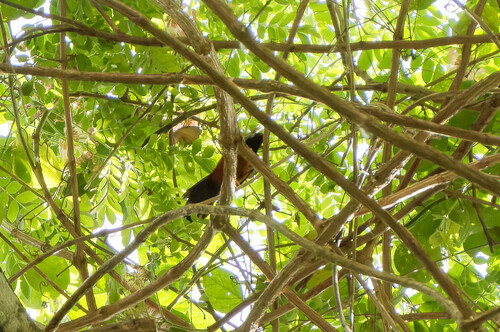
Compared to the other orioles of the Lesser Antilles, this oriole spots the most unusual plumage coloration. The Martinique oriole has mainly black plumage with a reddish-orange belly, and grows to 18–21 cm. The males of this species are slightly brighter than the females. It makes harsh scolding calls, and whistles. Whether females sing or not is currently being researched. It eats fruit from the canopy, berries and various insects, foraging alone, in pairs or with a group of family members. Breeding is generally observed between February–July, however breeding has been recorded in December.
Text from Wikipedia, licensed CC BY-SA 4.0.
When to see the Martinique Oriole
One bar for each month. Filled bars are the 9 months with records; pale bars are months with none. The wide bar is March, the month with the most records.
Where to see the Martinique Oriole
The map shades 1 country with regular records. Everything unshaded has no records. Countries are listed below the map.
About the Martinique Oriole
The Martinique oriole is a species of bird in the family Icteridae. It is endemic to Martinique, French West Indies. Martinique is a part of the Lesser Antilles, and is located in the Eastern Caribbean.
Text adapted from Wikipedia, licensed CC BY-SA 4.0.
Easily confused with
 Montserrat OrioleIcterus oberiThe Montserrat oriole is 20 to 22 cm (7.9 to 8.7 in) long.
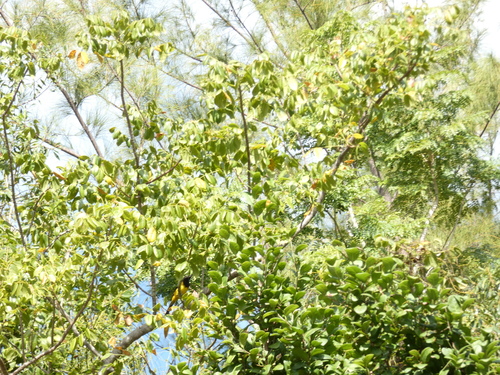 Bahama OrioleIcterus northropiThe Bahama oriole is a black and yellow oriole that has small white markings on the wings and tail.
 Bullock's OrioleIcterus bullockiorumBullock's orioles are sexually dimorphic, with males being more brightly colored than females.
Learn the Martinique Oriole in the BeakBrain App
Photo and call practice. Coming soon to iPhone and Android.
Play today's Daily BirdEvery photo and recording on this page is credited to its author under the licence shown. Spotted a problem with this page, or have a better photo? Contribute.