Learn what every symbol on the card means.Full credits and sources at beakbrain.com/symbols
 WetlandPlatform nestLarge · 866 g
ID tip
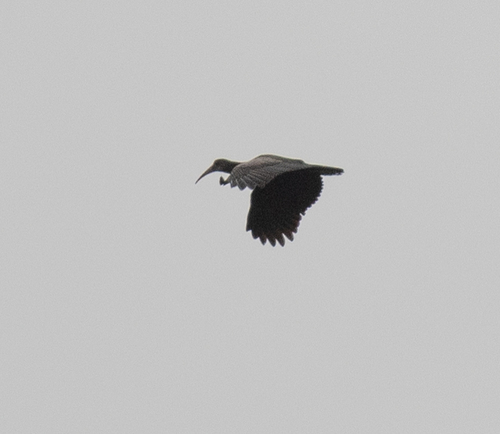
The spot-breasted ibis is a small, dark ibis (around 47 cm (19 in)), with long legs and a long red bill. The adult has a long, loose crest at the back of its head, which is dark brown to black and glossy green. Its plumage varies, but most usually tends to be brownish-blue. The mantle is brown and edged buff, but with a shiny green color. The rump and tail are blue-green, and the tail is slightly blue-green. It has blue-black wings and black underwing. The scapulars and the inner secondaries have an iridescent bronze green. Voice: They are usually silent and furtive when feeding on the ground. At dawn and dusk birds call in flight, giving a loud, raucous "ha-han".
Text from Wikipedia, licensed CC BY-SA 4.0.
When to see the Spot-breasted Ibis
One bar for each month. Filled bars are the 9 months with records; pale bars are months with none. The wide bar is October, the month with the most records.
Where to see the Spot-breasted Ibis
The map shades 11 countries with regular records, and 1 more in a lighter tone where the bird turns up only as a stray. Everything unshaded has no records. Countries are listed below the map.
Recorded as a rare visitor in Angola.
About the Spot-breasted Ibis
The spot-breasted ibis is a small, forest-dwelling ibis found in African lowland forests and swampy forested areas. Its preference for dense rainforests in tropical Africa means that it is seldom seen and is vulnerable to deforestation.
Text adapted from Wikipedia, licensed CC BY-SA 4.0.
Easily confused with
 Olive IbisBostrychia olivaceaThis relatively small ibis measures 65–75 cm in length, depending on subspecies.
 Sao Tome IbisBostrychia bocageiThe São Tomé ibis measures 248 mm on its wings, 75 mm on its bill, 52 mm on its tarsus, and 95 mm on its tail, on average.
 Wattled IbisBostrychia carunculataThe Wattled ibis is a medium-sized, dark brown, crested bird, distinguished by the combination of its dark color, its creast and its extensive white wing-patch.
Learn the Spot-breasted Ibis in the BeakBrain App
Photo and call practice. Coming soon to iPhone and Android.
Play today's Daily BirdEvery photo and recording on this page is credited to its author under the licence shown. Spotted a problem with this page, or have a better photo? Contribute.