Learn what every symbol on the card means.Full credits and sources at beakbrain.com/symbols
 ForestPlatform nestLarge · 1.1 kg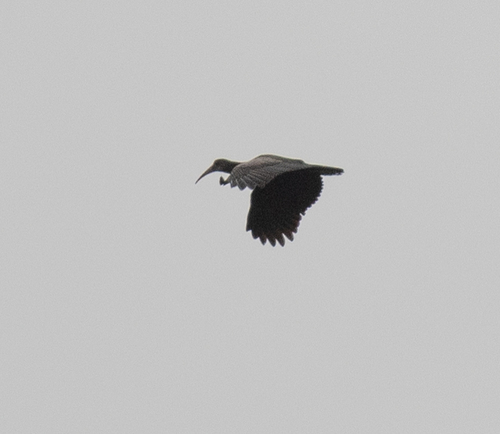
ID tip
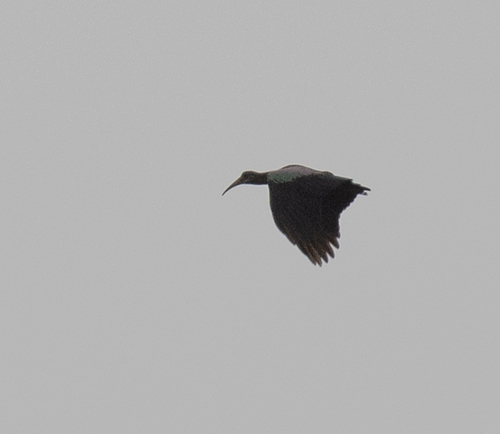
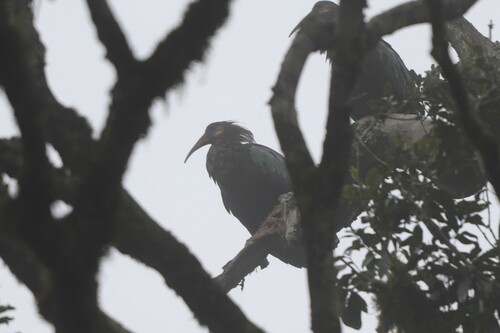
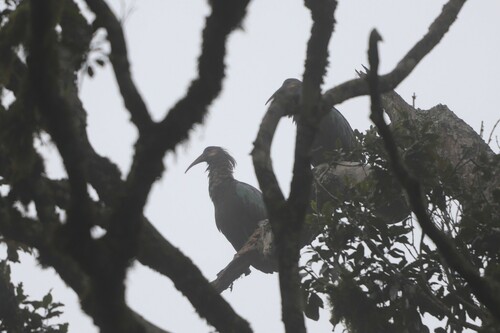
This relatively small ibis measures 65–75 cm in length, depending on subspecies. Recorded wing lengths in the various subspecies are 330–334 mm in olivacea, 309–355 mm in cupreipennis, 343–372 mm in akeleyorum, and 328 mm and 313 mm in males and females respectively of rothschildi. The culmen in olivacea measures 95–96 mm. Single male specimens of the subspecies akeleyorum, cupreipennis and rothschildi have reported culmen lengths of 108 mm, 85 mm and 95 mm respectively; with the corresponding lengths on females being 102 mm, 94 mm and 90 mm respectively. B. o. Voice: The call is a distinctive, loud, squawky "gar-wa", repeated several times and uttered in flight high above the trees. Reportedly, it only vocalizes in flight and then only during twilight. The rothschildi subspecies instead utters a call described as "HAAN-ha HAAN-ha". Other calls have been transcribed as "aka-a", "ka" and "kau".
Text from Wikipedia, licensed CC BY-SA 4.0.
When to see the Olive Ibis
One bar for each month. Filled bars are the 10 months with records; pale bars are months with none. The wide bar is February, the month with the most records.
Where to see the Olive Ibis
The map shades 6 countries with regular records, and 1 more in a lighter tone where the bird turns up only as a stray. Everything unshaded has no records. Countries are listed below the map.
Recorded as a rare visitor in Liberia.
About the Olive Ibis
The olive ibis is a species of ibis native to dense tropical forests in central Africa. Between 65 and 75 cm in length, it is a small ibis with olive plumage displaying an iridescent sheen. Four subspecies are recognized.
Text adapted from Wikipedia, licensed CC BY-SA 4.0.
Easily confused with
 Sao Tome IbisBostrychia bocageiThe São Tomé ibis measures 248 mm on its wings, 75 mm on its bill, 52 mm on its tarsus, and 95 mm on its tail, on average.
 Wattled IbisBostrychia carunculataThe Wattled ibis is a medium-sized, dark brown, crested bird, distinguished by the combination of its dark color, its creast and its extensive white wing-patch.
Learn the Olive Ibis in the BeakBrain App
Photo and call practice. Coming soon to iPhone and Android.
Play today's Daily BirdEvery photo and recording on this page is credited to its author under the licence shown. Spotted a problem with this page, or have a better photo? Contribute.