Learn what every symbol on the card means.Full credits and sources at beakbrain.com/symbols
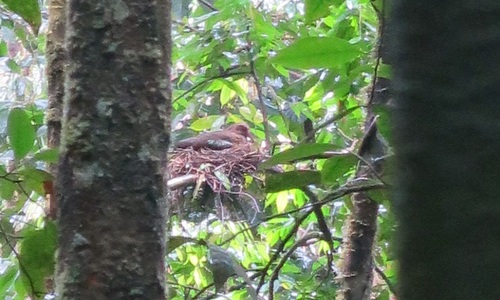
 ForestPlatform nestLarge · 1.1 kg
ID tip
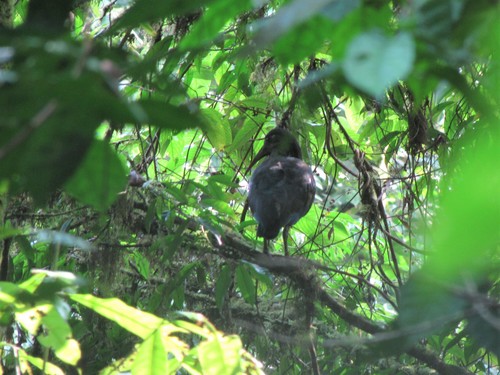
The São Tomé ibis measures 248 mm on its wings, 75 mm on its bill, 52 mm on its tarsus, and 95 mm on its tail, on average. The head is a dull olive color with black surrounding the eyes and the base of the bill. The tectrix (wing coverts) and mantle of the bird are slightly bronzed. Most of the time, the dwarf ibis is silent, but when it is disturbed, it gives off differing coughed grunts. When going to roost, it lets out a harsh honking. Its call could also be described as a stressed Walalalala.
Text from Wikipedia, licensed CC BY-SA 4.0.
When to see the Sao Tome Ibis
One bar for each month. Filled bars are the 8 months with records; pale bars are months with none. The wide bar is August, the month with the most records.
Where to see the Sao Tome Ibis
The map shades 1 country with regular records. Everything unshaded has no records. Countries are listed below the map.
About the Sao Tome Ibis
The São Tomé ibis, also known as the dwarf olive ibis or the dwarf ibis, is a critically endangered bird that is endemic to São Tomé off the western coast of Central Africa in the Gulf of Guinea. Discovered in the 1800s by Francisco Newton, it was once thought to be a subspecies of the larger olive ibis, but is now classified as a distinct species.
Text adapted from Wikipedia, licensed CC BY-SA 4.0.
Easily confused with
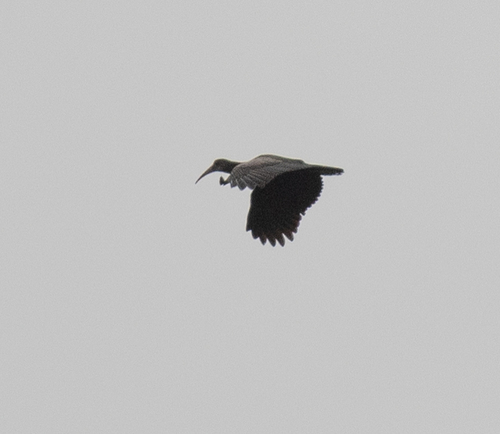 Olive IbisBostrychia olivaceaThis relatively small ibis measures 65–75 cm in length, depending on subspecies.
 Wattled IbisBostrychia carunculataThe Wattled ibis is a medium-sized, dark brown, crested bird, distinguished by the combination of its dark color, its creast and its extensive white wing-patch.
Learn the Sao Tome Ibis in the BeakBrain App
Photo and call practice. Coming soon to iPhone and Android.
Play today's Daily BirdEvery photo and recording on this page is credited to its author under the licence shown. Spotted a problem with this page, or have a better photo? Contribute.