Learn what every symbol on the card means.Full credits and sources at beakbrain.com/symbols
 ForestMedium · 202 g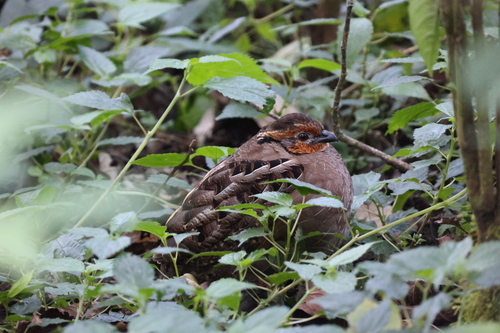


What the Singing Quail sounds like

ID tip
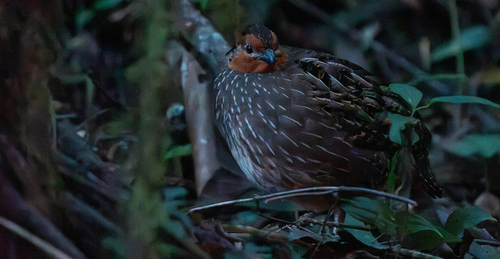
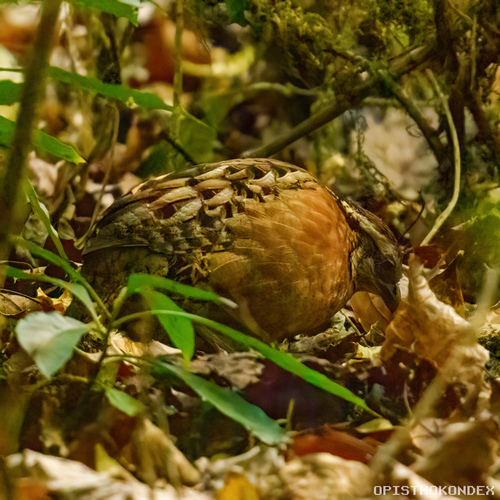
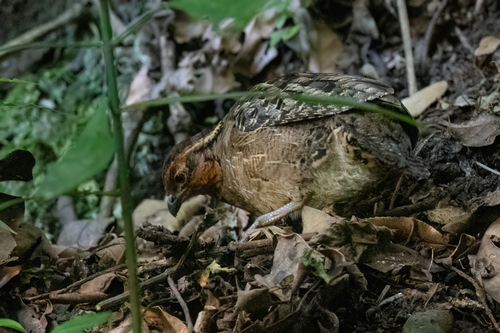
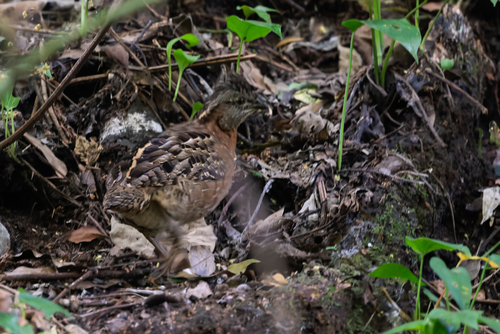
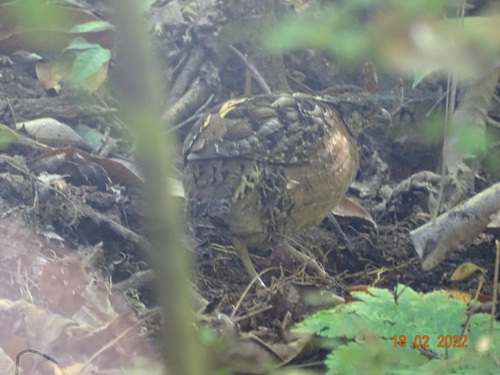
The singing quail is 20 to 23 cm (7.9 to 9.1 in) long. Males weigh 180 to 266 g (6.3 to 9.4 oz) and females 115 to 206 g (4.1 to 7.3 oz). The smallest birds are found near sea level and the largest in the mountains. Adult males of the nominate subspecies have a dark brown crown, a buff and black "collar", and a tawny orange face with a black streak behind the eye. The back and wings are mottled gray and brown with thin white streaks; the rump is olive brown or gray and has black vermiculation. The breast and belly are grayish brown with white streaks and the lower belly is white. Voice: The singing quail has a "oud, far-carrying, rhythmic song". It "commences with a series of hesitant, plaintive whistles, which increase in frequency and pitch into a rapidly delivered series, on varying pitch" and may be sung by several members of a covey. Coveys also give a weak twittering contact call.
Text from Wikipedia, licensed CC BY-SA 4.0.
When to see the Singing Quail
One bar for each month, and every month is filled: this bird is recorded here in all twelve. The wide bar is March, the month with the most records.
Where to see the Singing Quail
The map shades 5 countries with regular records. Everything unshaded has no records. Countries are listed below the map.
About the Singing Quail
The singing quail is a species of bird in the family Odontophoridae, the New World quail. It is found in Belize, El Salvador, Guatemala, Honduras, and Mexico.
Text adapted from Wikipedia, licensed CC BY-SA 4.0.
Easily confused with
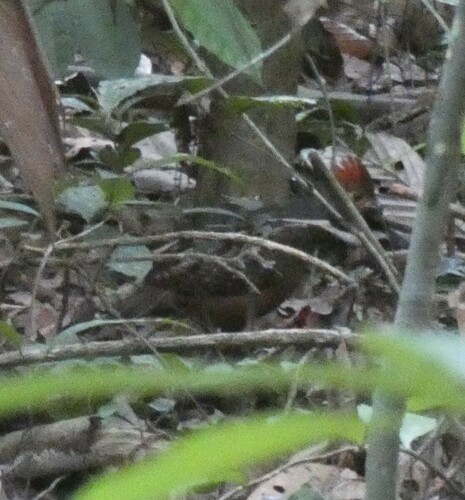 Marbled Wood QuailOdontophorus gujanensisAdult marbled wood quails grow to a length of between 23 and 29 cm (9 and 11 in).
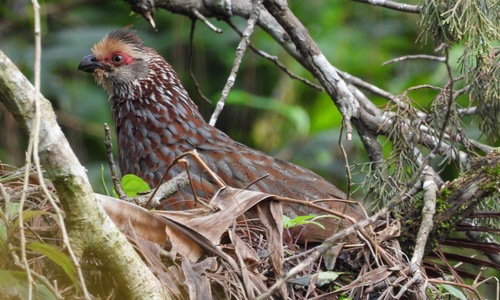 Buffy-crowned Wood PartridgeDendrortyx leucophrysThe buffy-crowned wood partridge is 28 to 35.5 cm (11.0 to 14.0 in) long.
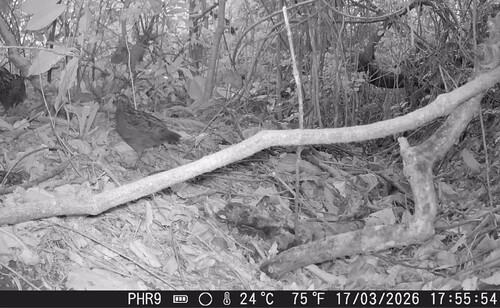 Spot-winged Wood QuailOdontophorus capueiraMale and female spot-winged wood quails are similar in appearance but the female is slightly smaller.
Side by side: Marbled Wood Quail vs Singing Quail · Buffy-crowned Wood Partridge vs Singing Quail · Singing Quail vs Spot-winged Wood Quail
Learn the Singing Quail in the BeakBrain App
Photo and call practice. Coming soon to iPhone and Android.
Play today's Daily BirdEvery photo and recording on this page is credited to its author under the licence shown. Spotted a problem with this page, or have a better photo? Contribute.