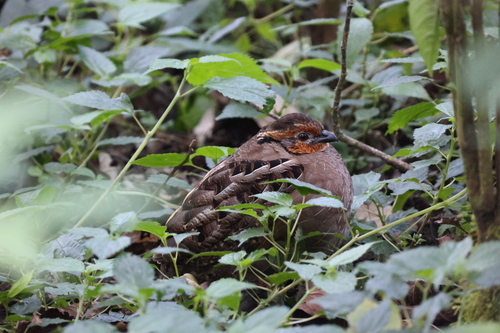
Singing Quail
Dactylortyx thoracicus
The singing quail is 20 to 23 cm (7.9 to 9.1 in) long. Males weigh 180 to 266 g (6.3 to 9.4 oz) and females 115 to 206 g (4.1 to 7.3 oz). The smallest birds are found near sea level and the largest in the mountains. Adult males of the nominate subspecies have a dark brown crown, a buff and black "collar", and a tawny orange face with a black streak behind the eye. The back and wings are mottled gray and brown with thin white streaks; the rump is olive brown or gray and has black vermiculation. The breast and belly are grayish brown with white streaks and the lower belly is white. Voice: The singing quail has a "oud, far-carrying, rhythmic song". It "commences with a series of hesitant, plaintive whistles, which increase in frequency and pitch into a rapidly delivered series, on varying pitch" and may be sung by several members of a covey. Coveys also give a weak twittering contact call.
ID text from Wikipedia, CC BY-SA 4.0

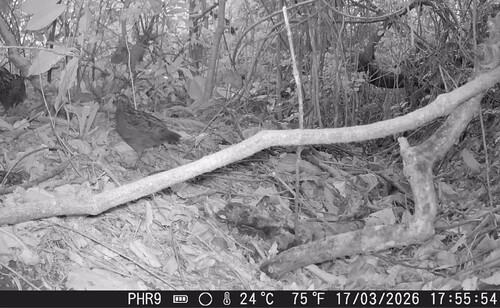
Spot-winged Wood Quail
Odontophorus capueira
Male and female spot-winged wood quails are similar in appearance but the female is slightly smaller. The bird has a reddish-brown crown with a loose crest, speckled with buff. The supercilium (stripe above the eye) and the chest-band are reddish-cinnamon. The upper parts are greyish-brown, with dark vermiculations and speckling, with the individual feathers on neck, mantle, back and scapulars having white streaks beside the shaft. The sides of the head, throat and underparts are slatey-grey. The legs are dark grey, the bill is blackish, the iris brown and the bare area around the eyes red.
ID text from Wikipedia, CC BY-SA 4.0
Learn this pair in the BeakBrain App
Photo and call practice. Coming soon to iPhone and Android.
Play today's Daily BirdPhotos and recordings are credited to their authors under the licence shown. Full profiles: Singing Quail and Spot-winged Wood Quail.