Learn what every symbol on the card means.Full credits and sources at beakbrain.com/symbols
 ForestScrapeMedium · 83 g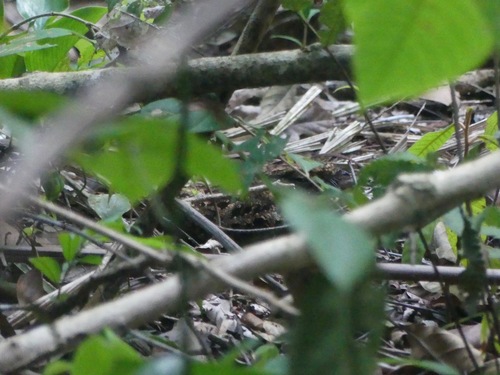
ID tip
The adult male silky-tailed nightjar has light grey-brown, vermiculated plumage with a strong blackish streak on the top of the head and the nape. It has blackish facial bristles and blackish spots with rufous on the side. Its hind-neck has narrow rufous-tawny half-collar plumage. The mantle, back, rump, and upper tail of a silky-tailed nightjar converts to blackish-brown with irregular patterns of buff and cinnamon. The breast is blackish-brown with short narrow bars of cinnamon and the belly is blackish-brown with blotches and irregular narrow bars of buff. Voice: The two subspecies of silky-tailed nightjar have significantly different songs. That of A. s. sericocaudatus is "a short tonal gliss connecting the two major pitch peaks ree-o-ree." That of A. s. mengeli "has an almost mournful, undulating doh wheo eeo." Both members of a mated pair sing, usually from a low perch or during low flight, and mostly at dawn and dusk.
Text from Wikipedia, licensed CC BY-SA 4.0.
When to see the Silky-tailed Nightjar
One bar for each month. Filled bars are the 7 months with records; pale bars are months with none. The wide bar is August, the month with the most records.
Where to see the Silky-tailed Nightjar
The map shades 6 countries with regular records. Everything unshaded has no records. Countries are listed below the map.
About the Silky-tailed Nightjar
The silky-tailed nightjar is a species of nightjar birds in the family Caprimulgidae. It is found in Brazil, Argentina, Bolivia, Paraguay, and Peru. Its natural habitat is subtropical or tropical moist lowland forests.
Text adapted from Wikipedia, licensed CC BY-SA 4.0.
Easily confused with
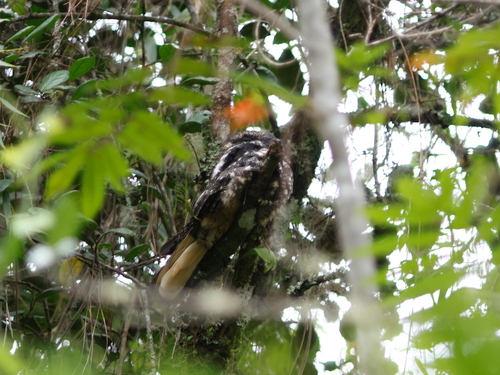 Hispaniolan NightjarAntrostomus ekmaniThe Hispaniolan nightjar is 26 to 30 cm (10 to 12 in) long.
 Cuban NightjarAntrostomus cubanensisThe Cuban nightjar's subspecies A. c. cubanensis is 25 to 29.5 cm (9.8 to 12 in) long.
 Puerto Rican NightjarAntrostomus noctitherusPuerto Rican nightjars, whose song is composed of rapid "whip" notes, are small birds about 22–23 cm in length, weighing 39–41 g.
Learn the Silky-tailed Nightjar in the BeakBrain App
Photo and call practice. Coming soon to iPhone and Android.
Play today's Daily BirdEvery photo and recording on this page is credited to its author under the licence shown. Spotted a problem with this page, or have a better photo? Contribute.