Learn what every symbol on the card means.Full credits and sources at beakbrain.com/symbols
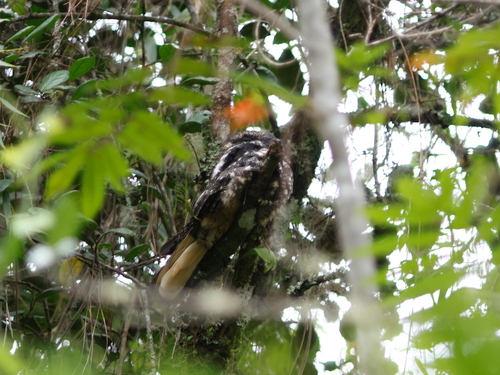
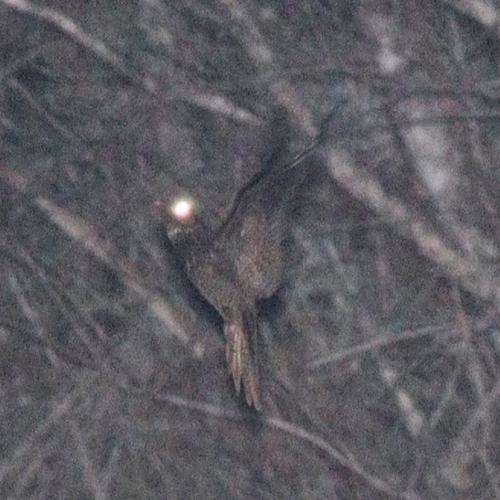
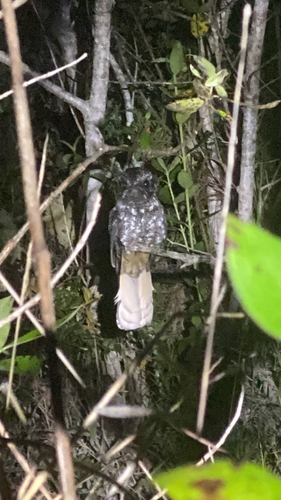

ID tip
The Hispaniolan nightjar is 26 to 30 cm (10 to 12 in) long. The upperparts are dark brown speckled with grayish buff, pale buff, and grayish brown, and the crown has broad black streaks. The tail is brown and the three outer pairs of feathers are broadly tipped with white (male) or buff (female). The innermost pair has grayish brown chevrons. The wings are brown with spots, bars, and mottling of lighter shades. Voice: The Hispaniolan nightjar's song is "a rather harsh, buzzy call of one syllable" that starts with a click and rises in pitch. Its apparent disturbance call is "low-pitched, brief calls, paraphrased as quat…quat…quat…".
Text from Wikipedia, licensed CC BY-SA 4.0.
When to see the Hispaniolan Nightjar
One bar for each month. Filled bars are the 6 months with records; pale bars are months with none. The wide bar is March, the month with the most records.
Where to see the Hispaniolan Nightjar
The map shades 2 countries with regular records. Everything unshaded has no records. Countries are listed below the map.
About the Hispaniolan Nightjar
The Hispaniolan nightjar is a nightjar species endemic to the Caribbean island of Hispaniola, which is shared by the Dominican Republic and Haiti.
Text adapted from Wikipedia, licensed CC BY-SA 4.0.
Easily confused with
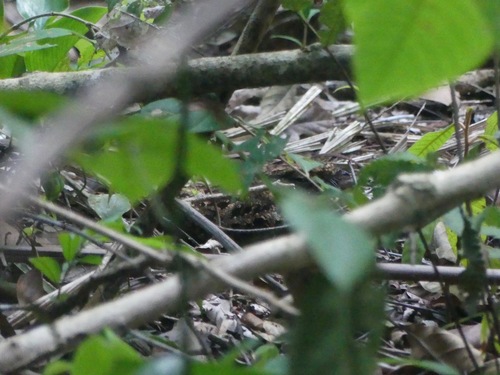 Silky-tailed NightjarAntrostomus sericocaudatusThe adult male silky-tailed nightjar has light grey-brown, vermiculated plumage with a strong blackish streak on the top of the head and the nape.
 Tawny-collared NightjarAntrostomus salviniThe tawny-collared nightjar is 23 to 25.5 cm (9.1 to 10 in) long.
 Cuban NightjarAntrostomus cubanensisThe Cuban nightjar's subspecies A. c. cubanensis is 25 to 29.5 cm (9.8 to 12 in) long.
Learn the Hispaniolan Nightjar in the BeakBrain App
Photo and call practice. Coming soon to iPhone and Android.
Play today's Daily BirdEvery photo and recording on this page is credited to its author under the licence shown. Spotted a problem with this page, or have a better photo? Contribute.