Learn what every symbol on the card means.Full credits and sources at beakbrain.com/symbols
 WoodlandCavity nestMedium · 147 g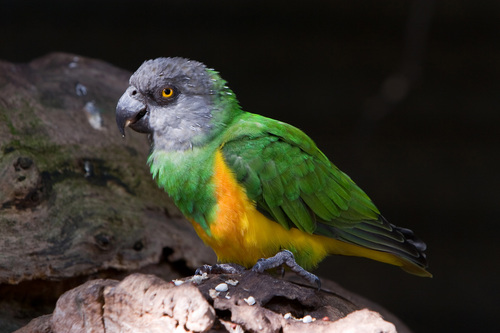


ID tip
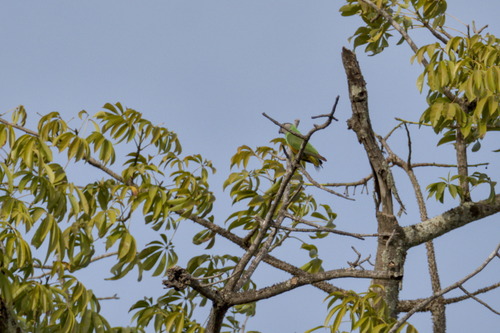
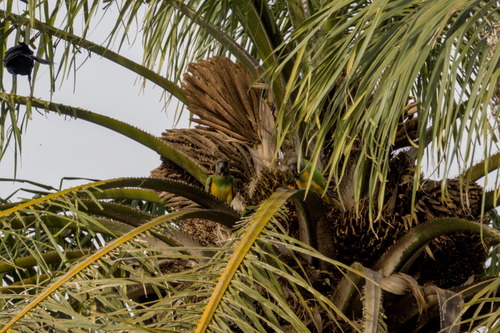
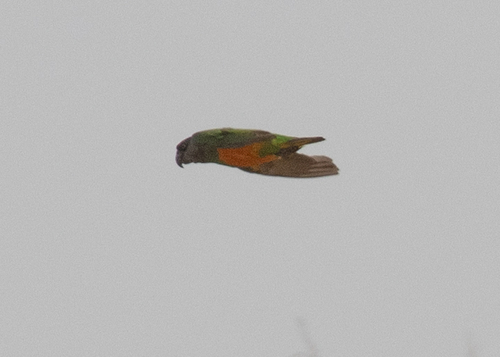
Senegal parrots are about 23 centimetres (9.1 inches) long, weigh about 120 to 170 grams (4.2 to 6.0 ounces). They have a relatively large head and beak for their overall size, and feathers form a short broad tail. Adults have a charcoal grey head, grey beak, bright yellow irises, green back and throat, and yellow underparts and rump. The yellow and green areas on a Senegal parrot's front form a V-shape resembling a yellow vest worn over green. Young juveniles have dark grey, almost black, irises, which change to light grey.
Text from Wikipedia, licensed CC BY-SA 4.0.
When to see the Senegal Parrot
One bar for each month, and every month is filled: this bird is recorded here in all twelve. The wide bar is November, the month with the most records.
Where to see the Senegal Parrot
The map shades 22 countries with regular records, and 8 more in a lighter tone where the bird turns up only as a stray. Everything unshaded has no records. Countries are listed below the map.
Recorded as a rare visitor in France, South Africa, Netherlands, Puerto Rico, United States, Türkiye, Belgium, Guadeloupe.
About the Senegal Parrot
The Senegal parrot is a parrot which is a resident breeder across a wide range of west Africa. It makes migrations within west Africa, according to the availability of the fruit, seeds and blossoms which make up its diet. It is considered a farm pest in Africa, often feeding on maize or millet. It is popular in aviculture.
Text adapted from Wikipedia, licensed CC BY-SA 4.0.
Easily confused with
 Brown-headed ParrotPoicephalus cryptoxanthusThe general plumage colour is green, indeed Sinclair et al., (1993) describe the species as "the greenest parrot of the sub-region".
 Cape ParrotPoicephalus robustusThe Cape parrot is a short-tailed moderately large bird with a very large beak used to crack all sorts of hard nuts and fruit kernels, especially those of African yellowwood trees (Podocarpus spp.).
 Red-bellied ParrotPoicephalus rufiventrisThe red-bellied parrot is a small parrot about 23 cm (9 in) long and weights 140 g (5 oz).
Side by side: Brown-headed Parrot vs Senegal Parrot · Cape Parrot vs Senegal Parrot · Red-bellied Parrot vs Senegal Parrot
Learn the Senegal Parrot in the BeakBrain App
Photo and call practice. Coming soon to iPhone and Android.
Play today's Daily BirdEvery photo and recording on this page is credited to its author under the licence shown. Spotted a problem with this page, or have a better photo? Contribute.