
Cape Parrot
Poicephalus robustus
The Cape parrot is a short-tailed moderately large bird with a very large beak used to crack all sorts of hard nuts and fruit kernels, especially those of African yellowwood trees (Podocarpus spp.). This contrasts with the closely related savanna species (Poicephalus fuscicollis) which feeds on a wide variety of tropical woodland trees such as marula, Commiphora spp. and Terminalia spp. These species are sexually dimorphic, with females typically sporting an orange frontal patch on the forehead.
ID text from Wikipedia, CC BY-SA 4.0
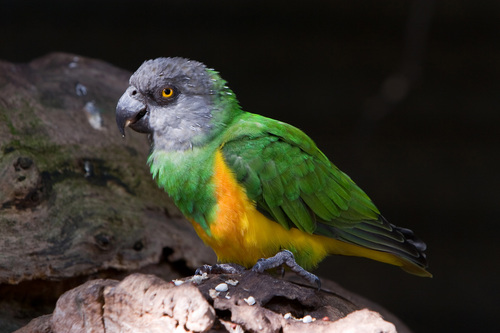
Senegal Parrot
Poicephalus senegalus
Senegal parrots are about 23 centimetres (9.1 inches) long, weigh about 120 to 170 grams (4.2 to 6.0 ounces). They have a relatively large head and beak for their overall size, and feathers form a short broad tail. Adults have a charcoal grey head, grey beak, bright yellow irises, green back and throat, and yellow underparts and rump. The yellow and green areas on a Senegal parrot's front form a V-shape resembling a yellow vest worn over green. Young juveniles have dark grey, almost black, irises, which change to light grey.
ID text from Wikipedia, CC BY-SA 4.0
Where you might meet both
Learn this pair in the BeakBrain App
Photo and call practice. Coming soon to iPhone and Android.
Play today's Daily BirdPhotos and recordings are credited to their authors under the licence shown. Full profiles: Cape Parrot and Senegal Parrot.